Accretion disks and the relativistic jets
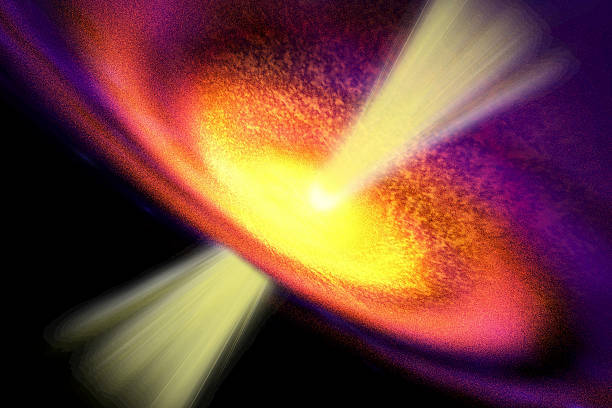
Start with the accretion disk. This is the swirl of gas, dust, plasma, and sometimes shredded stars that orbits a black hole. Picture a drain in a bathtub, but instead of water, you’ve got material heated to millions of degrees. Gravitational potential energy gets converted into kinetic energy as matter spirals inward. Friction between particles heats everything up until the disk glows in X-rays and visible light. For a supermassive black hole at the center of a galaxy, that disk can be larger than our entire solar system. It’s not a serene ring. It’s a chaotic, turbulent maelstrom where magnetic fields twist and snap, and where matter is accelerated to near-light speeds before it crosses the event horizon.
Now, not all of that material falls in. Some of it gets flung out. That’s where relativistic jets come in. These are narrow, high-speed beams of plasma that erupt from the poles of the black hole, perpendicular to the accretion disk. They move at velocities close to the speed of light—hence “relativistic.” The physics is still being nailed down, but the leading model involves magnetic fields threading the accretion disk and the black hole’s spin. The fields act like a cosmic slingshot, funneling charged particles into tight jets that can stretch for millions of light-years. Think of it as the black hole’s exhaust system, venting energy and matter back into its host galaxy and beyond.
Why should a guy in his twenties care about something happening billions of light-years away? Because these jets are real, and they’re active right now. The most famous example is in the galaxy M87, where the Event Horizon Telescope captured the first direct image of a black hole’s shadow in 2019. That same black hole, M87, shoots a jet visible across the electromagnetic spectrum. In our own Milky Way, Sagittarius A is quiet by comparison, but it still produces faint jets. When a black hole feeds aggressively—say, after swallowing a star—the jets flare up and can disrupt star formation across the entire galactic core. That’s not just cool. It’s fundamental to understanding how galaxies live and die.
For space travel enthusiasts, there’s another angle. Relativistic jets are nature’s particle accelerators. They produce cosmic rays and high-energy neutrinos that reach Earth. If humanity ever builds interstellar probes, we’ll need to navigate through environments shaped by these jets. Future space stations or colonies near galactic centers would have to account for radiation from active black holes. And if we ever harness the energy of a black hole—like in a theoretical “Kerr black hole” energy extraction scheme—we’d be tapping into the same spin and magnetic fields that drive jets. It’s not science fiction. NASA and other agencies already study jet physics to model everything from pulsars to gamma-ray bursts.
Let’s cut the fluff. Deep space isn’t comfortable. It’s extreme, violent, and ruled by forces we’re only beginning to understand. But accretion disks and relativistic jets are proof that the universe isn’t random. There’s a machinery to it. The black hole feeds, the disk spins, and the jets fire. It’s a cycle that repeats across every galaxy with a supermassive core. For the casual space enthusiast looking beyond tomorrow’s rocket launches, this is the real frontier. Not just getting to Mars, but understanding the engines that drive the cosmos. And if you want to know where space exploration is headed, you need to look at how the universe itself moves matter and energy around. The black hole at the center isn’t the end. It’s the beginning.
Space News
Latest Articles
New rockets, upcoming launches, and the stories shaping humanity's push off this planet. No astronomy degree required.