Autonomous Docking: How Spacecraft Park Themselves in Orbit
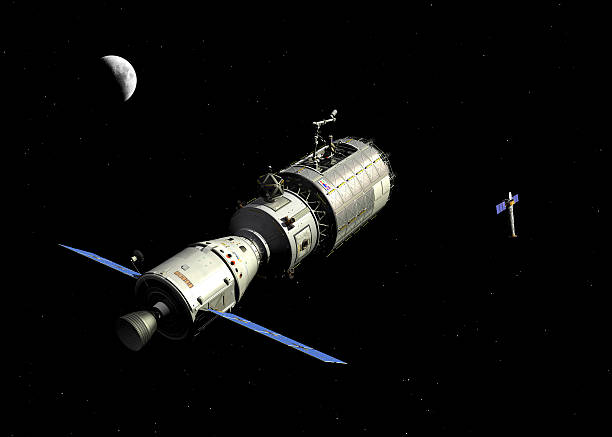
Rendezvous is the part before docking. It’s orbital math. A spacecraft can’t just point at the target and burn. It has to raise or lower its orbit to catch up, then slow down at the right moment. The target might be the ISS or another satellite. The chaser needs to know its own position, the target’s position, and how both are moving. Radar, lidar, optical cameras, and star trackers feed that data into a computer. It calculates relative navigation and fires thrusters.
The final approach is where autonomy gets real. At a few hundred meters, the chaser holds a stationkeeping point. Sensors scan the docking port. Retroreflectors and visual markers give the computer a known pattern. Machine vision estimates the target’s pose in six dimensions. The spacecraft creeps in. Soft capture rings touch first. Latches close. Hard capture hooks pull the vehicles together. Seals mate, and power and data connections route through the docking interface.
The hardware standard matters as much as the software. The International Docking System Standard, or IDSS, defines a common docking port. It is androgynous, so either side can be active or passive. Different spacecraft from different countries and companies can dock with each other. NASA’s Docking System is IDSS-compatible and flies on Crew Dragon and Starliner. Orion uses a similar system for lunar missions. This common port is why the ISS can host mixed vehicles without custom adapters.
Autonomy changes the risk equation. When a crew is on board, they can monitor and take over if something goes wrong. But autonomous docking removes split-second human decisions. Computers react faster and hold precise trajectories. More importantly, autonomy is mandatory for deep space. A signal from Mars can take up to 22 minutes to reach Earth. You cannot joystick a docking when the feedback loop is that slow. The spacecraft has to handle rendezvous, abort decisions, and final approach on its own.
That’s why docking tech is central to future plans. NASA’s Lunar Gateway will require Orion and the Starship Human Landing System to dock autonomously. SpaceX’s orbital refueling plan depends on two Starships meeting in orbit, docking, and transferring cryogenic propellant. That is much harder than docking a capsule. You need precise alignment, thermal control, and fluid transfer between massive vehicles. If that works, the economics of Moon and Mars missions change. You no longer have to launch everything with one rocket.
The tech also opens up satellite servicing. A robotic spacecraft could dock with a dead satellite, inspect it, refuel it, or attach a new module. Tugs could move old hardware to safer orbits. Large telescopes or space stations could be assembled in pieces, docked together in orbit. None of that happens without reliable rendezvous and docking. The same sensors that guide a cargo ship to the ISS can guide a repair robot to a broken satellite.
There are still hard problems. Lighting can wash out cameras. Thruster plumes can disturb the target. GPS is weak or unavailable in deep space. Docking with a tumbling object is another beast. Engineers solve these with redundant sensors, robust software, and abort modes that send the chaser safely away. The goal is not a perfect first attempt. The goal is a system that fails safe and tries again.
Autonomous docking is not flashy. It does not get the same attention as a rocket launch or a lunar bootprint. But it is the difference between visiting space and building there. Once spacecraft can park themselves reliably, routine rendezvous becomes normal. Cargo, crew, fuel, and hardware can move through orbit like trucks on a highway. That is how a space economy gets built. The future of space travel is about learning how to stop, line up, and connect.
Space News
Latest Articles
New rockets, upcoming launches, and the stories shaping humanity's push off this planet. No astronomy degree required.