Dark Matter and the Cosmic Web: The Invisible Scaffolding of the Universe
For decades, astronomers have known something is missing. When they measure how fast galaxies rotate, the outer stars move too fast. Without extra gravity, those galaxies should fling themselves apart. Clusters of galaxies show the same problem: galaxies move too quickly and the hot gas glows too hot. The math only works if there is roughly five times more matter than everything we can see. That missing mass is called dark matter. It is not a minor correction. It is the main ingredient.
The best evidence for dark matter doesn’t come from looking for the stuff itself. It comes from watching how gravity bends light. This is gravitational lensing. A foreground galaxy cluster can magnify and distort the light from galaxies behind it. When astronomers map those distortions, they can calculate where mass is. The maps don’t match the visible galaxies. They show huge blobs of gravity where there is little or no light. That is dark matter. It is invisible, but its gravity is not.
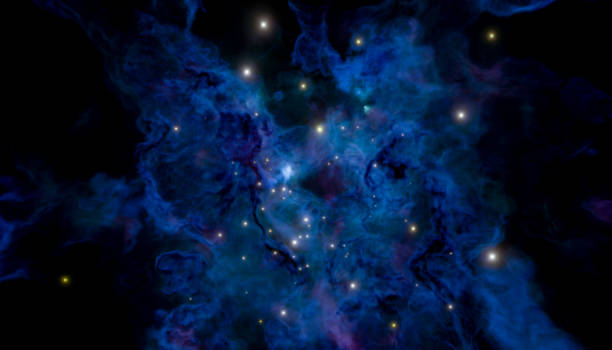
That gravity built the cosmic web. After the Big Bang, the universe was hot, dense, and almost smooth, with tiny ripples in density. Dark matter fell into those ripples first because it doesn’t interact with light or normal matter in ways that slow it down. It clumped under its own gravity. Normal gas eventually followed, pulled into the dark matter wells. The gas cooled, collapsed, and formed stars. Those stars gathered into galaxies. Galaxies gathered along filaments of dark matter. Where filaments crossed, you got massive clusters. The result is the large-scale structure we see today: sheets, walls, filaments, and huge empty voids. The cosmic web is not made of glowing gas. It is made of dark matter. The galaxies are just the lights on the scaffolding.
This is why dark matter matters for deep space. If you want to understand how the first galaxies formed, how black holes grew, or how the universe evolved over billions of years, you can’t ignore it. Dark matter sets the stage. It decides where gravity is strongest, where gas falls, and where stars are born. Without it, the universe would be a much emptier, smoother place. Galaxies like the Milky Way might not exist.
But what is dark matter? That is the hard part. Scientists have plenty of candidates, but no confirmed detection. One leading idea is WIMPs, weakly interacting massive particles that would be heavy, slow, and rarely interact with normal matter. Another is axions, extremely light particles that might behave more like waves. There are also sterile neutrinos, primordial black holes, and modified gravity theories that try to explain the observations without new particles. So far, every experiment has come up empty or unconfirmed. The hunt is still on.
The James Webb Space Telescope is already catching light from early galaxies, which can test how dark matter clumped in the early universe. Giant surveys like the Vera Rubin Observatory will map billions of galaxies and measure weak lensing, giving a sharper picture of dark matter’s distribution than ever before. Underground detectors are getting more sensitive, searching for rare collisions between dark matter particles and ordinary atoms. Space-based instruments are looking for dark matter decaying or annihilating into detectable signals.
The invisible universe is not a side quest. It is most of the mass. It is the reason the visible universe has any shape at all. Dark matter doesn’t care about light, but it cares about gravity, and gravity writes the rules. The cosmic web is the proof. Every galaxy you see is a bright knot on a dark thread. The future of space travel and deep space science depends on understanding that dark scaffolding. We can’t see it yet. But we can see what it does. And that is enough to know it’s there.
Space News
Latest Articles
New rockets, upcoming launches, and the stories shaping humanity's push off this planet. No astronomy degree required.