Final shuttle flight and the museum delivery
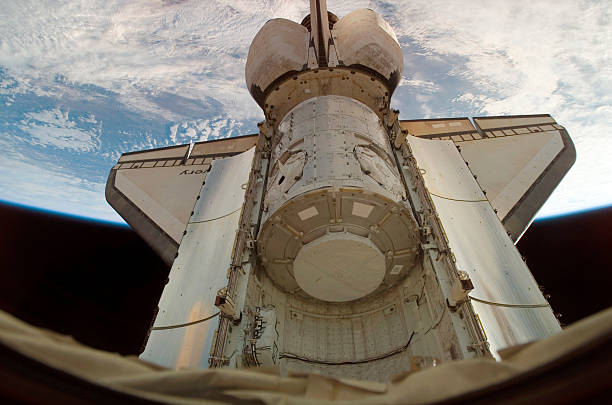
STS-135 launched on July 8, 2011, carrying a crew of four: Commander Chris Ferguson, Pilot Doug Hurley, and Mission Specialists Rex Walheim and Sandy Magnus. The mission was originally a contingency flight—a backup plan if the last scheduled shuttle, Endeavour’s STS-134, failed or got delayed. But NASA had already announced the shuttle program’s end in 2004 under the George W. Bush administration’s Vision for Space Exploration, which shifted focus toward the Moon and Mars. By 2011, the decision was concrete. STS-135 would be the last. The crew’s job was to deliver the Multi-Purpose Logistics Module Raffaello, filled with nearly 10,000 pounds of spare parts, supplies, and experiments to the International Space Station. This was no nostalgic joyride. They worked a twelve-day mission that included two spacewalks and four docked days with the station crew. Every minute was accounted for. The orbiter carried a system to test how micrometeoroid debris impacts spacecraft, a materials science experiment, and a backup for the station’s urine-to-water recycling system. It was business-first, because the station still had to run after the shuttles stopped.
But the unspoken weight of the shuttle’s last flight was everywhere. Ferguson, the commander, was the only rookie among the crew—he had flown on STS-124 and STS-126, but never commanded. Walheim was on his third flight. Magnus had already spent months on the station. They knew they were closing the book on a vehicle that had no direct replacement. The Orion capsule wouldn’t fly crews until 2022. For nearly a decade, American astronauts would be hitching rides on Russian Soyuz rockets. That wasn’t trivia; it was a national security gap that the crew felt personally. On landing day, Ferguson said from the runway, “The space shuttle has changed the way we view the world. It’s changed the way we view our universe. There’s a lot of emotion today, but one thing’s indisputable: America’s not going to stop exploring.“
After the crew walked away, the real work started. NASA had to turn three flyable orbiters into museum pieces. Discovery went to the Smithsonian’s Steven F. Udvar-Hazy Center in Virginia. Endeavour went to the California Science Center in Los Angeles. Atlantis stayed at the Kennedy Space Center Visitor Complex in Florida. The problem? These were vehicles never designed to be static displays. They had hydraulic systems, toxic propellants in thrusters, and sensitive thermal tiles that couldn’t handle weather exposure. NASA spent years decommissioning each orbiter: draining fuel, removing sensitive avionics, and sealing the crew modules shut. Atlantis, for instance, had its three main engines removed and replaced with inert replicas so the public could see the nozzles without worrying about residue. The cargo bay doors were permanently left open at the museum, a deliberate choice to let visitors see the payload bay and the 15-meter robotic arm. The museum teams even installed a slide-walkway so you could look down into the flight deck from above. Ferguson and Hurley helped build that display, guiding curators on exactly how to position switches and seats so it looked authentic to a crew about to launch.
The delivery missions themselves were logistical nightmares. Endeavour’s piggyback flight on a 747 across the country to Los Angeles took three days in September 2012, drawing huge crowds but raising concerns about the 747’s aging structure. Atlantis was trucked from the Vehicle Assembly Building to the visitor complex on a massive transporter—a ten-mile journey that took two days and required moving trees, traffic lights, and signs along the route. The museum at Kennedy spent $100 million on a building designed specifically to house the orbiter, tilted at a 43-degree angle so you see it as if it’s still in orbit. That wasn’t showmanship. It was engineering. The display structure had to support 170,000 pounds of steel, ceramic, and aluminum, with climate control to prevent corrosion from Florida humidity.
What you need to understand is that the shuttle museum deliveries weren’t clean, elegant endings. They were compromises. NASA wanted to keep at least one orbiter for potential future use, but the political will was gone. Instead, you got a vehicle that flew 33 missions, spent 307 days in space, and carried the first American woman commander, Eileen Collins, now parked under a steel roof for tourists. Atlantis’s final museum display includes a cutaway showing the thermal tiles and the original cockpit. You can see the control panels, the hand grips, the switches worn from thousands of button pushes. That’s as close as you’ll get to what the astronauts felt on the launch pad, waiting for three million pounds of thrust to ignite.
The final shuttle flight and its museum delivery mission succeeded in one specific way: it proved that American spaceflight could end with dignity, even if the plan for what came next was uncertain. The orbiters are now silent, but they’re not dead. They’re teaching a new generation that going to space isn’t a fantasy. It’s a set of choices, constraints, and final checks on a checklist. And when you see Atlantis hanging in that Florida hangar, you’re looking at the last physical proof that we once had a vehicle that could do it all—launch like a rocket, land like a plane, and then sit quiet enough for a museum curator to adjust the lighting.
Space News
Latest Articles
New rockets, upcoming launches, and the stories shaping humanity's push off this planet. No astronomy degree required.