Saturn V F-1 still the king of thrust
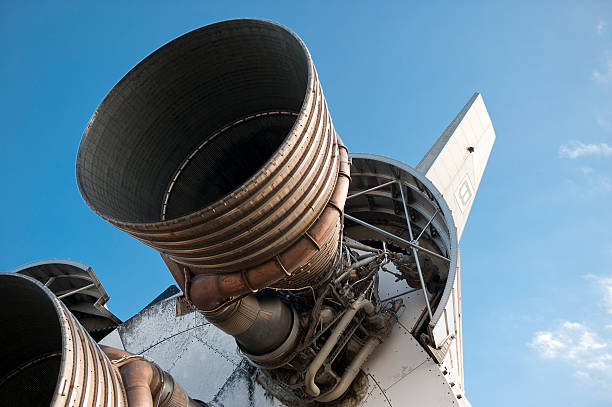
The F-1 was built to do one thing: lift a massive payload off the pad and keep it moving. Each engine produced about 1.5 million pounds of thrust at sea level, and five of them were clustered on the first stage of the Saturn V. That cluster delivered a combined thrust of roughly 7.5 million pounds, enough to accelerate a fully loaded spacecraft weighing over six million pounds off the launch pad. To put that in perspective, the Saturn V’s first stage burned through 4.5 million pounds of propellant in just two and a half minutes. That’s not gentle acceleration; that’s controlled violence.
What made the F-1 unique was its scale. The engine bell alone measured over 12 feet in diameter, and the turbopump that forced propellant into the combustion chamber delivered 55,000 horsepower—more than a modern aircraft carrier’s powerplant. The combustion chamber operated at around 1,000 pounds per square inch, burning RP-1 kerosene and liquid oxygen at temperatures exceeding 5,000 degrees Fahrenheit. These numbers aren’t just impressive; they’re the reason the F-1 has no real successor. Modern engines like the SpaceX Merlin or the Blue Origin BE-4 use multiple smaller chambers to scale thrust, but no single chamber has ever matched the F-1’s output. The RD-170 used on Russia’s Energia rocket comes close with about 1.6 million pounds, but that engine uses four smaller nozzles fed by one turbopump, not a single massive chamber.
Why didn’t anyone just build a bigger F-1? Because physics pushes back hard. At that scale, combustion instability becomes a nightmare. The F-1 program spent years fighting resonant pressure waves that could destroy the engine in fractions of a second. Engineers eventually fixed it with injector plate baffles and design tweaks learned through hundreds of test firings, but the cost and complexity were enormous. Building an even larger single-chamber engine today would mean solving the same instability problems from scratch, and modern engine design leans toward clusters of smaller, reliable chambers like the Raptor vacuum engine on Starship. That approach is easier to manufacture and test, but it doesn’t give you a single, iconic thrust source.
For space enthusiasts tracking the future, this matters because the F-1 represents a path we’ve largely abandoned. The Space Shuttle’s RS-25 engines were throttleable and reusable, but each produced only 418,000 pounds of thrust—less than a third of an F-1. SpaceX’s Raptor reaches around 500,000 pounds in its full-thrust configuration. Blue Origin’s BE-4 delivers 550,000 pounds. These are impressive numbers, but none of them break seven figures. And while Starship’s 33 Raptors will produce more total thrust than the Saturn V, each individual engine is still dwarfed by the F-1’s output.
The F-1’s legacy isn’t just about numbers, though. It’s about confidence. When the Saturn V lifted off, those five engines didn’t just push metal upward; they pushed humanity out of the cradle. Every Apollo mission that went to the Moon started with that same full-throttle roar. That visceral connection between raw power and human achievement is why the F-1 remains the benchmark. New engines might be smarter, more efficient, or cheaper, but none have yet taken a human being off a launch pad with that kind of authority.
So what’s next? NASA’s Space Launch System uses four RS-25 engines for its core stage, supplemented by two solid rocket boosters. That total thrust is comparable to the Saturn V’s, but the RS-25s are still smaller, more refined engines. The real push for single-chamber big thrust may come if someone resurrects concepts like the F-1B, a modernized version that Rocketdyne proposed in 2013. That engine would have used 1990s manufacturing tech to simplify the design, increasing thrust to 1.8 million pounds while cutting cost and weight. No customer ever funded it, but the idea proves the design isn’t obsolete—it’s just waiting for a mission that demands it.
Until then, the F-1 sits alone at the top. It’s the heavyweight champ that never got dethroned, retired on its own terms after going undefeated. For anyone interested in how humanity truly reached for the stars, understanding why the F-1 still matters is essential. It wasn’t the most efficient or the most elegant engine. It was just the strongest, and sometimes that’s exactly what you need.
Space News
Latest Articles
New rockets, upcoming launches, and the stories shaping humanity's push off this planet. No astronomy degree required.