The Kardashev scale and the energy utilization
Kardashev broke it into three types. A Type I civilization harnesses all the energy available on its home planet. That’s about 10¹⁶ watts for Earth—solar, wind, geothermal, fossil fuels, the works. We’re not even there yet. We’re maybe a 0.7 on that scale, still burning coal and arguing about electric vehicles. A Type II can capture the entire energy output of its star—roughly 10²⁶ watts. Think Dyson spheres, giant orbital structures that wrap around a sun to siphon every photon. And a Type III civilization controls energy on a galactic scale—10³⁶ watts, enough to power something like a supermassive black hole engine or a civilization that spans billions of stars.
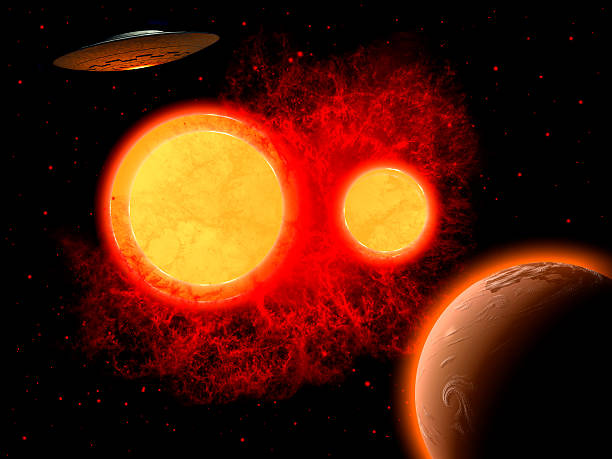
Now, here’s where deep space gets interesting. The Great Silence isn’t just about radio signals not reaching us. It’s about the fact that if any civilization had reached Type II or Type III, we would see them. Not hear them. See them. A Dyson sphere, even partially built, would block starlight in infrared wavelengths. We’ve looked. We see nothing. No massive heat signatures. No artificial megastructures. No energy theft from stars. That suggests one of two things: either nobody out there has made it past Type I, or they’re hiding. But hiding on that scale is almost impossible. If you’re burning a star’s worth of energy, you leave a footprint across the galaxy. That footprint is missing.
So why would advanced civilizations stay quiet? One grim theory: the Great Filter. Maybe the jump from Type I to Type II is the bottleneck. Think about it. To build a Dyson swarm, you need to mine asteroids, disassemble planets, and manage incomprehensible amounts of energy. That kind of power doesn’t just enable exploration—it enables self-destruction. A Type I civilization that develops nuclear fusion, AI, or bioweapons might wipe itself out before it ever builds that first orbital power station. The data from our own history isn’t encouraging. We’ve come close multiple times in just seventy years of nuclear capability. Scale that up to a thousand-year timeline, and the odds look bleak.
Another possibility is that advanced civilizations simply don’t want to be found. Deep space is vast, dangerous, and resource-rich. If you’re Type II, you don’t need to colonize other star systems—you can build everything you need in your own solar system. Why broadcast your location to potential predators? The Dark Forest hypothesis, popularized by Liu Cixin’s Three-Body Problem, argues that any civilization that reveals itself is a target. In a universe of finite resources, the smart move is silence. That would explain why we see a quiet, empty cosmos: everyone who’s made it past Type I is listening, not shouting.
But there’s a more unsettling take. What if deep space itself prevents the transition? The energy requirements for Type II are so massive that they might exceed the physical stability of matter itself. A Dyson sphere isn’t just a construction project—it’s a physics gamble. The materials needed to withstand stellar radiation, the engineering to manage orbital mechanics, the heat dissipation—these constraints might be hard limits. No amount of intelligence can bend physics. So maybe Type II is a theoretical ceiling, not a real destination. Civilizations hit a wall at Type I and either burn out or stagnate.
What does this mean for us? The Kardashev Scale isn’t just a cool concept for science fiction. It’s a mirror. We’re standing at the edge of Type I, looking into deep space, and we see nothing because nobody else made it across. Or they made it and chose to disappear. Either way, the silence isn’t empty. It’s a warning. If we want to survive long enough to touch the stars, we need to get our energy act together without blowing ourselves up first. Because out there, in the black between galaxies, the real test isn’t how much energy you can use—it’s whether you can handle it without going silent forever.
Space News
Latest Articles
New rockets, upcoming launches, and the stories shaping humanity's push off this planet. No astronomy degree required.