Artificial gravity and the rotating tether concept
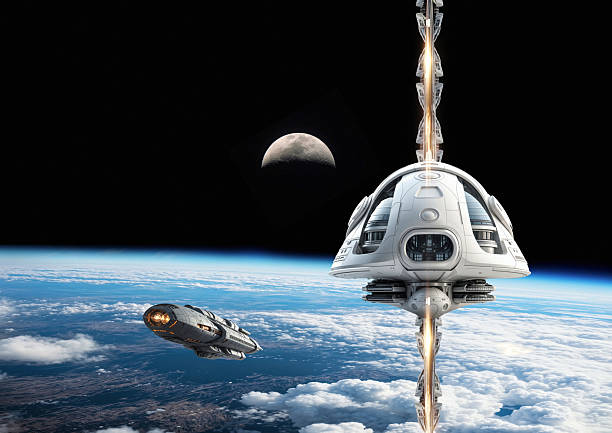
Let’s be clear about what we are up against. On the International Space Station, astronauts exercise two hours a day and still lose about one percent of their bone mass per month. After six months, their bodies look like they aged decades. A Mars mission lasting three years would be catastrophic without countermeasures. The obvious solution is to spin the habitat. Centrifugal force pushes you outward, creating a feeling of weight that mimics gravity. The problem is that building a spinning ring large enough to avoid nausea from Coriolis effects—those weird sideways forces that make your inner ear freak out—requires massive structures. We are talking about diameters of hundreds of meters to get a comfortable rotation rate of around two rotations per minute. Constructing that in orbit with current rocket launch costs is absurd.
Enter the rotating tether. The idea is elegant and brutally simple. Instead of building one giant spinning wheel, you connect two habitats with a long cable, then set the whole system rotating around a central point. The two masses act as counterweights. Each habitat experiences artificial gravity proportional to its distance from the center and the rotation speed. By adjusting tether length or spin rate, you can dial in Earth-normal gravity, Martian gravity, or something in between for different purposes. A tether just a few hundred meters long can give you full gravity at a rotation rate that feels natural. The engineering challenge shifts from building a rigid structure hundreds of meters wide to deploying a strong cable and controlling the spin. That is far more achievable with current materials like Kevlar or ultra-high molecular weight polyethylene.
This concept is not just theoretical. NASA has studied tethered satellite systems for decades. The Gemini 11 mission in 1966 tethered a spacecraft to an Agena target vehicle and spun them to generate a tiny amount of artificial gravity. That was fifty-eight years ago. The physics is settled. The hold up has always been logistics and cost, but that is changing. As launch costs drop thanks to Starship and other reusable rockets, building orbital infrastructure becomes economically viable. The rotating tether is the cheapest path to artificial gravity because it minimizes mass. You are not lifting a giant metal ring into orbit. You are lifting two modules, a spool of cable, and a deployment mechanism. That cuts your launch mass in half or more compared to spinning a monolithic station.
Now consider the commercial future. Private companies like Axiom Space are already planning commercial space stations. Blue Origin talks about building an orbital park. If you slap a rotating tether on any of those, you instantly make them more attractive for long-duration stays. Tourists paying millions for a week in orbit might tolerate floating, but workers on a lunar or Mars base cannot. More importantly, industrial processes benefit from variable gravity. Crystallization, semiconductor manufacturing, and even biological experiments could use different g-levels in the same facility. A tethered pair of habitats gives you that flexibility. You want low gravity for one module and full gravity for the other? Tweak the tether length or redistribute mass. Simple.
The biggest obstacle is not technology—it is human psychology and inertia. Tethers present a collision risk. If the cable snaps, both habitats fly apart. But that risk is manageable with redundancy, multiple strands, and autonomous monitoring. Tethers also require careful spin-up and spin-down to avoid oscillations. Engineers have solved these problems on paper. What is missing is a real mission to prove it works at scale. That is where commercial space companies can step in. A private venture could launch a tethered demo system in the next five to ten years, making it the default design for any serious orbital habitat.
For the guys reading this on a Tuesday night, wondering if space colonization is just billionaire fantasy, the rotating tether is the reality check. It is not flashy. There are no glowing rings like in “2001.“ But it is the difference between a trip that ruins your body and a home where you can raise kids, grow food, and build industries. If you care about living in space instead of just visiting, this is how we do it.
Space News
Latest Articles
New rockets, upcoming launches, and the stories shaping humanity's push off this planet. No astronomy degree required.