Lunar lava tubes and the habitat possibility
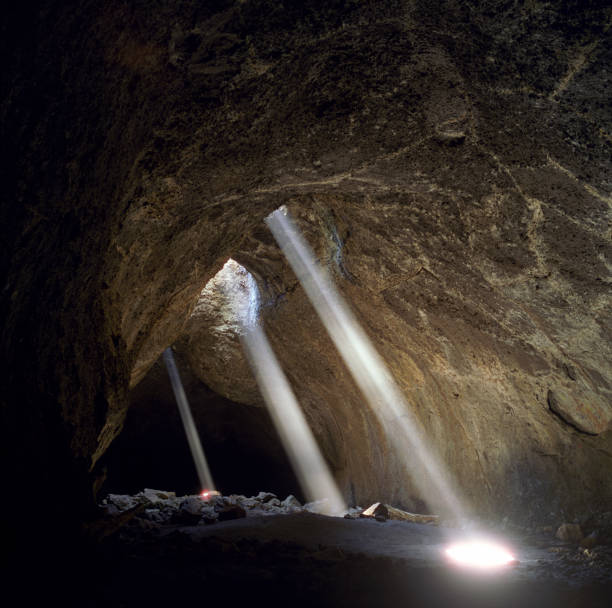
Lunar lava tubes are the vertical caves formed by ancient volcanic eruptions. Millions of years ago, the Moon was geologically active, and flowing lava carved out massive tunnels just beneath the crust. When the lava stopped flowing, the tunnels emptied and left behind stable, tube-shaped voids. Some of these tubes are enormous. Orbital radar data from Japan’s SELENE probe suggests a tube beneath the Marius Hills region is nearly a hundred meters wide and several kilometers long. That’s big enough to fit a small city. And they’re not just holes in the ground. Recent analysis indicates many of these tubes have intact roofs—meaning they’re sealed, pressurized environments waiting for human tenants.
The habitat possibility is straightforward. If you live underground, you solve the three biggest threats to long-term lunar survival. First, radiation. The Moon has no magnetic field or atmosphere. Cosmic rays and solar particle events hit the surface hard. But just a few meters of lunar regolith—the dusty rock layer above the tube—blocks nearly all of that. A tube roof gives you built-in shielding for free. Second, temperature. The surface swings through hundreds of degrees. Inside a lava tube, the temperature is stable at around -20°F. That’s still cold, but it’s consistent. You don’t need complex thermal systems to keep electronics and habitats from frying or freezing. Third, micrometeorites. A tube roof thick enough to stop radiation will also stop the tiny, high-speed rocks that pockmark every exposed surface. You go in and you’re safe.
But here’s the part that gets interesting. These tubes are not just shelters. They are destinations with built-in infrastructure. The same volcanic processes that carved the tubes also left behind basaltic rock rich in metals like iron and titanium. Future settlers can mine those resources directly. The tubes themselves have vertical skylights and collapsed entrances that can serve as docking ports for landers. You don’t need to drill your own access shaft—nature already provided one. And the stable internal environment means you can pressurize the tube with breathable air and build modular habitats inside it. You inflate a structure, connect it to the tube floor, and you have a livable space that’s already protected from the outside.
There is also the mobility factor. Lava tubes are not isolated caves. They form networks. A crew landed in one location could traverse kilometers underground to reach distinct scientific sites—geological features, ice deposits at the poles, or even other landing zones. That changes the entire logistics of lunar exploration. Instead of building one base and exhausting its surroundings, you have a highway system that lets you expand over time. And because the tubes maintain a constant temperature, you can store equipment and fuel without thermal management. A lunar tube network becomes the backbone of a permanent outpost.
The science community is already pushing for a dedicated mission to confirm tube stability and map their interiors. NASA’s proposed Moon Diver mission would send a rover to rappel into a skylight and survey a tube up close. But even without that data, the case is strong enough that multiple international space agencies are planning landings near known tube openings. The European Space Agency has a concept for a “Moon Village” built into a cave. China’s Chang’e program is investigating tubes for future robotic settlements. This is not a hypothetical. This is the next wave.
For the casual space enthusiast, here’s the takeaway. The Moon is not a dead rock we visit and leave. It is a place we will live. Lava tubes are the reason why. They give us a ready-made environment that mitigates the Moon’s worst hazards while offering natural resources and mobility. The Artemis base won’t be a dome on the surface. It will be a pressurized tunnel network beneath it. That’s the destination. And it’s closer than you think.
Space News
Latest Articles
New rockets, upcoming launches, and the stories shaping humanity's push off this planet. No astronomy degree required.