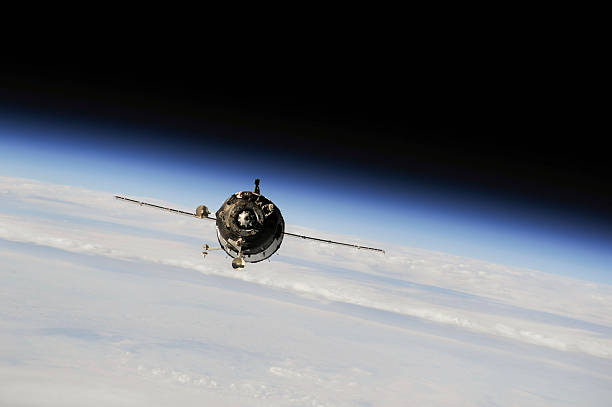
Berthing versus docking and the arm interface

Let’s cut through the jargon. Docking means a spacecraft flies itself into a pressurized mating port under its own power, using onboard sensors, thrusters, and a computer brain that calculates approach angles and closing velocities. The vehicle handles the final approach autonomously, though ground controllers or the crew can intervene if something goes sideways. The key hardware here is the docking mechanism itself—typically a ring that aligns, captures, and then retracts to create a hard, airtight seal. NASA’s Common Berthing Mechanism (CBM) is actually a berthing system, but the agency’s newer International Docking System Standard (IDSS) is what you see on Crew Dragon and Starliner. That system is designed for what engineers call “soft capture” followed by “hard capture,” meaning the vehicle makes initial contact with latches, dampens relative motion, and then pulls itself tight.
Berthing, on the other hand, is a two-step process where a spacecraft does not actually dock itself. Instead, the vehicle approaches to a safe standoff distance, typically a few meters away, and then a robotic arm—the Space Station Remote Manipulator System (SSRMS), better known as Canadarm2 on the ISS—reaches out and grabs it. The arm then maneuvers the craft to a port and latches it in place. The spacecraft never fires its thrusters during the final connection. This method was standard for uncrewed cargo vehicles like the original SpaceX Dragon, Orbital’s Cygnus, and Japan’s HTV. The advantage? No need for expensive, complex docking hardware on the vehicle. The station’s arm does the heavy lifting, literally and figuratively. The downside? It’s slower, requires a human operator (or ground control) to drive the arm, and ties up the arm during the entire berthing process.
Now, here’s where the technology gets interesting. The real unsung hero in modern berthing and docking is the arm interface—the physical and data connection between the grappling fixture on the spacecraft and the end effector of the robotic arm. That interface isn’t just a mechanical claw. It’s a high-tech handshake that transfers power, data, and video, and it has to survive the thermal vacuum of space, micrometeoroid impacts, and years of decay. The SSRMS uses a “snare” design: three cables inside the end effector tighten around a grapple fixture, then pull it into a hard mount. Once grabbed, the arm can provide power to the vehicle, upload software updates, and even perform inspections before the final mate. That interface is why Cygnus can stay attached for months, running experiments without its own docking ring.
Docking eliminates the need for an arm entirely, but it replaces it with something arguably more complex: the docking ring’s capture envelope. That envelope has to compensate for relative velocity errors, misalignment, and rotational drift. The IDSS uses a system of radial guide petals and a central alignment key to funnel the two spacecraft together. And because docking happens fast—usually under 0.1 meters per second—the mechanism must absorb kinetic energy without damaging seals or bending structural elements. That’s why modern docking collars are built with shock absorbers, electromagnetic dampers, and backup mechanical latches that can fire even if the guidance computer fails.
Why does this matter to you as a space enthusiast? Because the choice between berthing and docking is shaping the next generation of spacecraft. The Artemis program, aiming to put humans back on the Moon, is betting on docking for the Orion capsule and the Lunar Gateway. Gateway will have multiple docking ports designed for the IDSS, allowing Crew Dragon, Starliner, and future vehicles to swap crews without an arm. But the Lunar Gateway also plans to use a robotic arm—the Canadian-built Canadarm3—for berthing cargo modules and assembling the station in orbit. So the future won’t be one or the other; it’ll be a hybrid system where docking handles crew transport and emergency escapes, while berthing handles large, low-cost cargo modules that can’t afford fancy avionics.
The bottom line is that neither method is inherently better. Docking is faster, autonomous, and ideal for human-rated vehicles that need to abort rapidly. Berthing is cheaper, safer for fragile cargo, and doesn’t require every visiting vehicle to reinvent the navigation wheel. What matters is the interface. Whether it’s a grapple fixture or a docking ring, the physical and digital handshake between spacecraft and station is the quiet technology that makes the whole enterprise work. As commercial space stations from Axiom and Orbital Reef come online in the 2030s, they’ll have to decide which handshake protocol to standardize. If they choose wrong, spacecraft from different vendors might not be able to dock at all. That’s the kind of engineering headache that turns a routine resupply mission into a multi-month software patch. So the next time you watch a capsule link up with the ISS, pay attention to the arm—or the lack of one. That single detail tells you everything about how that spacecraft was built, how much it cost, and how much risk its designers were willing to accept.
Space News
Latest Articles
New rockets, upcoming launches, and the stories shaping humanity's push off this planet. No astronomy degree required.