Communication across light-years and the signal delay
Here’s the cold math. Light travels at about 186,000 miles per second. That sounds fast, but space is absurdly big. Right now, the Voyager 1 probe is about 15 billion miles from Earth. A radio signal traveling at light speed takes roughly 22.5 hours to get there, and another 22.5 hours to get back. That’s nearly two days for a single exchange of “How are you?” “Fine.” Now scale that to a mission to the nearest star system, Proxima Centauri, which sits about 4.2 light-years away. A one-way message takes 4.2 years. A round-trip conversation lasts over eight years. You send a question in 2030, your great-aunt’s grandkids get the reply in 2038.
This isn’t just an inconvenience. It redefines what “control” means. Forget real-time driving of a rover or commanding a ship to dodge debris. By the time your command arrives, the situation has changed completely. Deep space missions are autonomous by necessity. The spacecraft has to think for itself, navigate hazards, make decisions, and even perform repairs without waiting for Mission Control. For any interstellar mission, the human crew—or the AI aboard an unmanned probe—is on its own. Earth is not a parent; it’s a distant advisor who sends postcards every few years.
What does that do to mission planning? Everything slows down. Data from scientific instruments—like magnetic fields, radiation levels, or high-resolution images—needs to be compressed, prioritized, and transmitted in bursts. The bandwidth is pathetic. Voyager 1 transmits at about 160 bits per second. That’s slower than a 1980s dial-up modem. Future missions will use lasers instead of radio, boosting data rates, but the delay remains. A laser link to Mars takes between 3 and 20 minutes each way, depending on orbital positions. To the next star, it’s years.
But here’s where it gets interesting for you as a space enthusiast. The signal delay forces a psychological shift. Any interstellar mission is a multigenerational project. The people who launch the mission will not see the results. The people who receive the first signal from a star system will be their grandchildren. This isn’t romantic; it’s brutal. It means every message we send must be clear, concise, and meaningful. There’s no room for small talk when your sentence takes a decade to arrive.
For the Interstellar Mission Horizon, this reality shapes the tech we’re building right now. Forget warp drives for a second. Focus on quantum entanglement, which some hope could allow instantaneous communication. It doesn’t work that way. Quantum entanglement cannot transmit information faster than light—that’s a party trick, not a telephone. The real work is in error correction, high-gain antennas, and deep space networks that can punch a signal through the noise of cosmic radiation. Engineers are designing “bottleneck” relays—orbital stations parked at gravitational points that can hold messages and forward them on tight schedules.
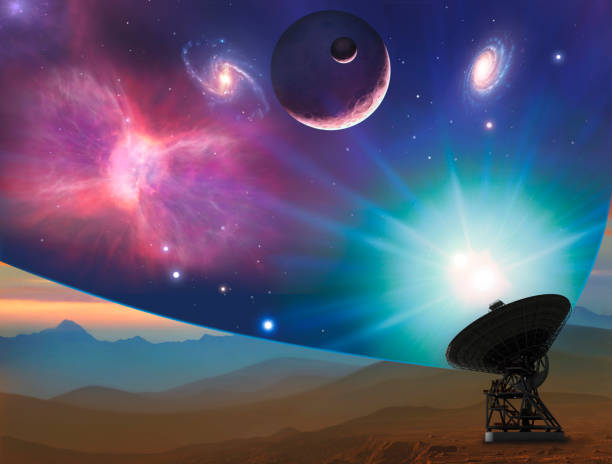
There’s also the problem of signal degradation. Over light-years, even a focused laser beam spreads out. By the time it reaches Earth from another star, it’s a whisper. You need massive receiving arrays. The current Deep Space Network uses dishes up to 70 meters across. For interstellar signals, the receiving infrastructure will have to be orbital or lunar, built on a scale we haven’t attempted. This isn’t science fiction. This is the hard, thankless work of making sure we don’t miss a single photon from a civilization that might not even exist yet.
Bottom line: communication across light-years is a one-way game. You send a data package, you wait. If something goes wrong, you don’t ask for help. You fix it or die. That’s the true frontier. It’s not about speed; it’s about patience, redundancy, and engineering for failure. If you’re serious about the Interstellar Mission Horizon, stop thinking about instant chat and start respecting the lag. It’s the only thing standing between a dream and a dead silence.
Space News
Latest Articles
New rockets, upcoming launches, and the stories shaping humanity's push off this planet. No astronomy degree required.