Falling into a black hole and the time dilation
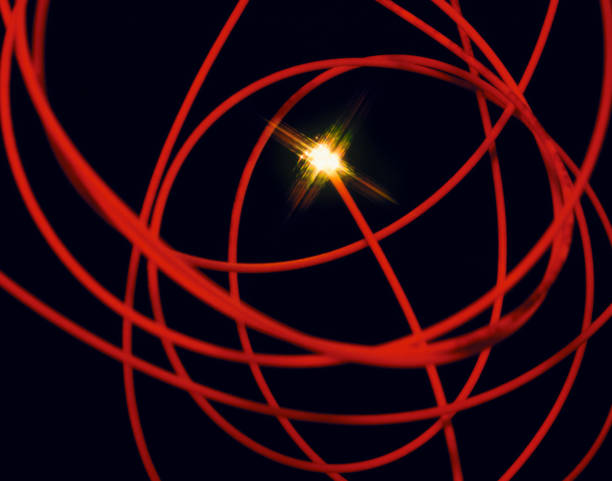
First, you need to understand the event horizon. It’s not a physical surface. There’s no wall, no glowing ring, no dramatic visual barrier. The event horizon is the point of no return. Once you cross it, the escape velocity exceeds the speed of light. Nothing—not even a signal, not even a flashlight beam—can get back out. From the outside, you simply vanish from the observable universe. But from your perspective inside the ship, the trip is just beginning.
Here’s where time dilation kicks your brain in the teeth. According to general relativity, gravity slows down time. The stronger the gravitational field, the slower clocks tick relative to a distant observer. As you approach a black hole, that effect becomes extreme. From the viewpoint of someone back on Earth or on a station far away, your clock appears to run slower and slower the closer you get to the event horizon. They would see you moving in slow motion as you fall. In fact, they would never actually see you cross the horizon. Your image would redshift, fade, and freeze forever on the edge—a ghostly snapshot of your last moment before the universe lost you forever.
But inside your ship, you feel none of that. Your own clock ticks normally. You check your watch, your heartbeat stays steady, and your coffee still brews in the same four minutes it always did. That’s the core of relativity: time is relative. What changes is the relationship between your time and everyone else’s time. As you fall, the universe outside appears to speed up. You’d watch distant stars age, galaxies spin, and eons pass in what feels like hours. This isn’t just a cool special effect—it’s a direct consequence of spacetime warping under extreme gravity.
Now, let’s talk about what kills you. Popular science often says you get “spaghettified”—stretched into a thin strand by tidal forces. That’s real, but only for small black holes. For a stellar-mass black hole, those tidal forces would rip you apart long before you reach the event horizon. Your feet feel much more gravity than your head, so your body gets pulled like taffy. Ouch. But here’s the twist nobody mentions: for a supermassive black hole, like the one at the center of our galaxy, the event horizon is so far from the singularity that tidal forces are almost negligible. You could cross the horizon without feeling a thing. You’d just keep falling into a darkness you can never escape.
That leads to the real mind-bender. Once you’re inside the event horizon, “out” stops existing as a direction. Every possible path leads toward the singularity. You can’t turn around. You can’t even slow down. Spacetime itself is flowing inward faster than you can thrust away. So you fall, and time continues to do its weird dance. Depending on the black hole’s mass and rotation, the singularity could be a point or a ring, and your trip inside might last seconds or hours of your own time. Meanwhile, billions of years might pass outside.
Why should a guy in his twenties care about this? Because black holes aren’t just abstract theories anymore. We’ve photographed one. Gravitational wave detectors catch them colliding. Deep space missions are mapping the supermassive black hole at the Milky Way’s center. The Event Horizon Telescope team keeps releasing sharper images. This isn’t a what-if thought experiment—it’s real science with real implications for how we understand spacetime, the early universe, and possibly even time travel.
For the casual space enthusiast, the takeaway is simple. Falling into a black hole isn’t a quick death. It’s a slow, stretched, relativistic journey where your clock and everyone else’s clock disagree completely. The universe outside you accelerates into the far future while your own life ticks away normally. That’s not sci-fi—that’s hard physics. And as we push deeper into deep space, understanding that distortion of time becomes essential. Whether we’re sending probes, planning interstellar missions, or just dreaming of the stars, black holes remind us that time isn’t a steady river. It’s a rubber band, and the universe loves to stretch it.
So next time you watch a spaceship dive into a black hole on screen, remember the reality: the survivors weren’t the ones who escaped. They were the ones who stayed behind, watching a frozen image of their friend while the entire future of the cosmos blinked by in an instant. That’s the true cost of crossing the event horizon. And for anyone serious about deep space, that’s a fact worth holding onto.
Space News
Latest Articles
New rockets, upcoming launches, and the stories shaping humanity's push off this planet. No astronomy degree required.