Fire suppression in microgravity is terrifying
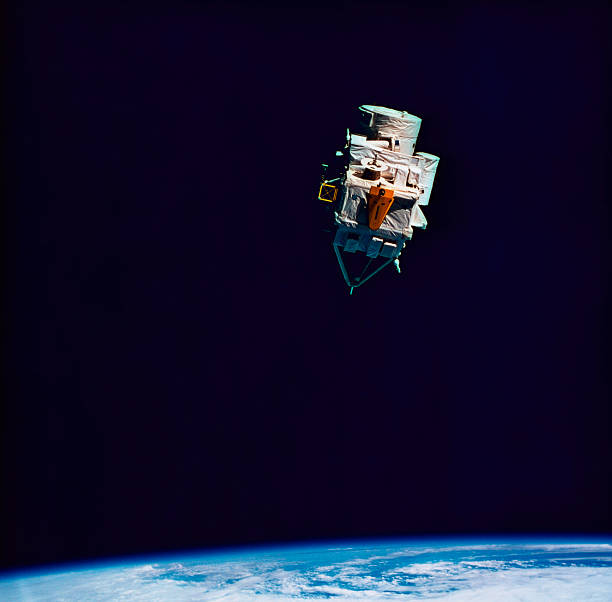
In normal conditions on Earth, fire rises. Hot gases expand, become less dense, and float upward, pulling fresh oxygen into the base of the flame. That feedback loop is what keeps a campfire roaring. Remove gravity, and that loop breaks. Instead of a tidy teardrop-shaped flame, you get a slow-moving, spherical ball of fire that creeps across surfaces like a viscous liquid. It burns cooler than a terrestrial flame—sometimes at a fraction of the temperature—but it’s also stealthier. It creeps along wiring, insulation, and panels, often smoldering invisibly inside sealed electronics for hours before breaking into open flame. By the time you see it, you may already be breathing toxic combustion byproducts.
The technical challenge of suppressing this kind of fire is brutal. On Earth, we use water sprinklers, foam, CO2, or halon-based systems that rely on displacing oxygen or smothering the flame. In space, those same tools can become lethal. Water, for example, doesn’t fall to the floor. It floats in blobs, and if you spray it in microgravity, it forms a conductive mist that can short-circuit critical electronics or drift into your own breathing path. Halon is now banned under the Montreal Protocol because of its ozone-depleting properties, and its replacements—like HFCs—are being phased out for climate reasons. CO2 works by displacing oxygen, but in a sealed spacecraft, that can asphyxiate the crew faster than the fire itself.
So what do we actually use? The current standard on the International Space Station is a system called the Portable Fire Extinguisher, which deploys a fine mist of carbon dioxide and a proprietary additive. It’s designed to knock down flames without creating a hazardous electrical path, and it works reasonably well for small, localized fires. But it’s not perfect. The mist can still drift unpredictably, and the CO2 concentration in a small module can spike dangerously if the fire continues to smolder. NASA also relies on smoke detectors that sample the air continuously, but they’re sensitive to false alarms—cooking, dust, even astronaut farts have triggered them.
More advanced systems are in development. One promising technology is vacuum-based fire suppression, where a rapid pressure drop sucks the oxygen out of a compartment, starving the fire instantly. This works in theory, but it requires airtight seals and precise pressure control. In a habitat with multiple interconnected modules, you could accidentally depressurize the whole ship. Another approach uses nitrogen or argon inerting systems, flooding the space with an oxygen-diluting gas before a fire even starts. That’s used in cargo holds on the ISS today, but it’s expensive and adds mass.
The most terrifying part isn’t the hardware—it’s the unknown. We have only limited data on how fires spread in microgravity. Most experiments have been small-scale, either in drop towers (which give you about 5 seconds of freefall) or on parabolic flights (which give you 20 seconds at a time). The longest microgravity combustion tests ever conducted were on the Space Shuttle and the ISS, and they involved burning small samples of wire insulation or foam in controlled chambers. Nobody has ever had to fight a real, uncontrolled fire in orbit. The closest thing was a small electrical fire on the Mir space station in 1997, which was contained by the crew using a handheld extinguisher and a lot of guts.
That lack of empirical data means our models are still guesses. Fire growth rates, soot transport, visibility, and toxicity in a zero-g environment are all poorly understood. If a fire starts in a habitation module, the crew might have minutes to react before the smoke renders them unconscious. And because the fire doesn’t produce a clear upward plume, you can’t tell where the source is by looking. You have to crawl through zero-g, following a smoke trail that could be looping back on itself.
For long-duration missions to Mars, this is a showstopper. A fire on a Mars transit habitat would not be survivable—not with current technology. The crew could be days away from a suitable abort, and the ship would be an isolated aluminum can with no resupply. The entire life support system would be compromised. That’s why fire suppression research is quietly one of the most urgent priorities in spaceflight technology. Without a reliable way to kill a fire without killing the crew, we aren’t ready for deep space.
For now, every time a smoke alarm goes off on the ISS, a little bit of adrenaline hits the crew. They know the drill. They know the extinguisher is close. But they also know that if the fire wins, there’s no escape pod that can outrun a spreading flame in a vacuum. That’s what makes fire suppression in microgravity genuinely terrifying—not the fire itself, but the thin line of technology that stands between you and a very bad day.
Space News
Latest Articles
New rockets, upcoming launches, and the stories shaping humanity's push off this planet. No astronomy degree required.