First module Zarya and the Russian backbone
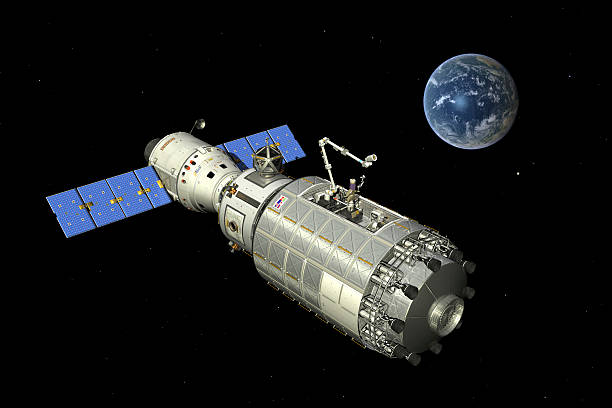
Zarya’s original mission was brutally practical: provide propulsion, power, and storage until the rest of the station could catch up. Built by the Khrunichev State Research and Production Space Center in Moscow under contract to Boeing, the module was a Russian design with American funding. That hybrid nature set the tone for every ISS mission that followed. Zarya carried two large solar arrays that generated about 3 kilowatts of power, plus fuel tanks that held nearly six tons of propellant. Its primary job was to keep itself—and later, the growing station—in the correct orbit. Without Zarya, the ISS would have drifted out of position within weeks, burning up on reentry before the second module even arrived.
The first critical mission for Zarya was simply surviving on its own. After launch, it spent two weeks in orbit unmanned, waiting for the Space Shuttle Endeavour to bring up the Unity node. During that solo flight, ground controllers in Moscow had to fire Zarya’s thrusters to adjust its orbit multiple times. Any failure here would have ended the entire ISS program before it started. The mission was a success, and on December 6, 1998, Endeavour crew members Nancy Currie and James Newman used the shuttle’s robotic arm to attach Unity to Zarya. That first docking was a milestone, but it was also the beginning of Zarya’s real work: acting as the structural and propulsion backbone for every subsequent assembly mission.
Over the next two years, Zarya’s thrusters were fired hundreds of times to keep the station stable as heavy modules like the Russian Zvezda service module and the American Destiny laboratory were added. Each time a new piece arrived, Zarya’s propulsion system had to compensate for the shifting center of mass and the extra drag from increased surface area. This was not glamorous work. It was grinding, continuous orbital maintenance that required precise commands from both Russian and American mission control. Zarya’s fuel supply became a running concern. By 2000, engineers knew that without regular resupply, the module would run dry within three years, effectively paralyzing the station.
This led to one of Zarya’s most critical missions: the installation of the Zvezda service module in July 2000. Zvezda took over most of the propulsion duties, allowing Zarya to transition into a storage and cargo role. That shift wasn’t a downgrade; it was a planned handoff. Zarya’s original design had always assumed it would be supplemented. The mission to integrate Zvezda required Zarya to maintain a precise orbit for three months while delays plagued the Russian rocket program. Controllers kept Zarya in a holding pattern, burning fuel sparingly, until Zvezda finally launched and docked automatically. The success of that mission proved the entire ISS concept was viable—two nations could coordinate complex orbital rendezvous with aging hardware under political and financial pressure.
After Zvezda took over, Zarya’s mission became quieter but no less essential. It served as a storage depot for food, water, spare parts, and experimental gear. Its pressurized volume of about 70 cubic meters gave crews room to breathe and work during the early years when the station was still cramped. Zarya also housed critical environmental control systems, including carbon dioxide scrubbers and oxygen generators, that kept the first resident crews alive. When the Expedition 1 crew arrived in November 2000, they lived and worked in Zarya alongside Zvezda. The module was their kitchen, their workshop, and their emergency shelter.
In the 2010s, Zarya’s role shifted again. As newer Russian modules like Rassvet and Poisk arrived, and as American commercial vehicles like SpaceX’s Dragon began docking, Zarya became a backup node. Its docking ports handled visiting vehicles when primary ports were occupied. Its computers served as a redundant network hub. And its aging thrusters, though rarely used, remained a last-resort capability for emergency orbital adjustments. The module even survived a 2007 incident when a computer glitch caused the station to lose attitude control for nearly 24 hours. Zarya’s systems helped stabilize the situation until engineers could reboot the main computers.
Today, Zarya is the old man of the ISS. It has been in orbit for over 25 years, far beyond its original five-year design life. Its solar arrays are degraded, its original computers have been replaced twice, and its hull has been pitted by micrometeoroids. But its mission is far from over. Zarya remains structurally integral to the station, and any future decommissioning plans will require careful orbital maneuvers to avoid turning the module into debris. For now, it continues to store cargo, provide redundant systems, and serve as a living monument to the missions that started it all.
The takeaway for any space enthusiast is this: the ISS isn’t a single achievement; it’s a chain of missions, each one dependent on the last. Zarya was the first link, and its quiet, stubborn reliability made everything else possible. No flashy science, no dramatic spacewalks—just a Russian-built tank of fuel and solar cells that refused to quit. That’s the backbone of the ISS.
Space News
Latest Articles
New rockets, upcoming launches, and the stories shaping humanity's push off this planet. No astronomy degree required.