South pole water ice and the permanently shadowed craters
Forget the Apollo landing sites. They are historical landmarks, not future homes. The equatorial regions of the Moon are a desert in the most brutal sense of the word. Temperatures swing from 250 degrees Fahrenheit during the day to -250 at night. There is no water, no atmosphere, and no protection from radiation. A human being can survive there for a few days inside a well-shielded lander, but you cannot live there long-term. To do that, you need the resources of the South Pole.
Here is the straightforward physics. The Moon’s axis is tilted only about 1.5 degrees relative to the Sun. This means the floors of deep craters at the poles are in permanent shadow. The sun never rises high enough to peek over the rim. In those dark, cold traps, temperatures never rise above -330 degrees Fahrenheit. For billions of years, comets and water-rich asteroids have slammed into the Moon, and the water vapor that boiled off simply drifted around until it froze in these cold sinks. The result is a massive, accessible cache of ancient water ice.
Why does that matter for a return plan? Because water is the consumable of spaceflight. It is not just for drinking. You break it apart with solar power into hydrogen and oxygen, and you have rocket fuel. You have breathable air. You have radiation shielding. Hauling water from Earth to the Moon costs roughly a million dollars per kilogram. The entire Artemis architecture, every lander and every Gateway station, is designed around the assumption that we can harvest this ice. That is the destination. That is the entire business case.
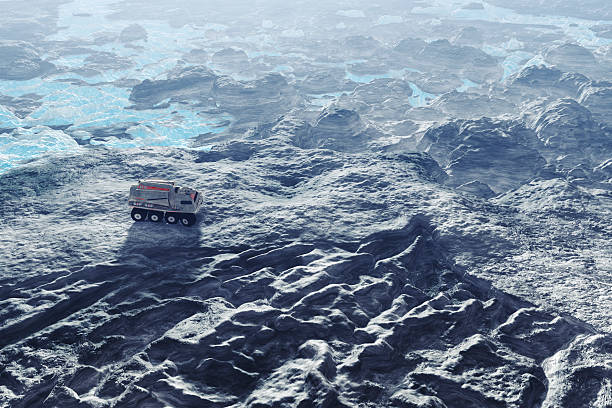
The specific craters you need to watch are Shackleton, Shoemaker, Faustini, and Haworth. These are deep, ancient impact basins near the lunar South Pole. Shackleton is the most famous because its rim is one of the few places in the region that receives near-constant sunlight, making it a prime spot for solar arrays. You land on the illuminated rim, then drive or teleoperate robots down into the dark crater floor to mine the ice. The terrain is brutal. The lighting is tricky because the sun is always low on the horizon, creating long, disorienting shadows. But the payoff is enormous.
NASA’s VIPER rover, which was cancelled and then reinstated in various forms, was specifically designed to map these ice deposits. The Korean Pathfinder Lunar Orbiter (Danuri) is already in orbit mapping the polar regions with a sensitive camera that can see into those dark craters. China’s Chang’e-7 mission, slated for 2026, is heading straight for the South Pole with a lander, a rover, and a flying probe designed to hop directly into a permanently shadowed crater. Everyone is racing for the same real estate.
The destination matters because of logistics. If you cannot make fuel on the Moon, every kilogram of cargo you want to send deeper into the solar system has to be launched from Earth at enormous cost. If you can make fuel at the South Pole, the Moon becomes a gas station. You land, you refuel, and you push off to Mars or the asteroid belt. The South Pole isn’t just a cool place to visit. It is the strategic chokepoint for the entire next century of human expansion into space.
For a casual space fan, this is the single most important fact to grasp: the Artemis program is not about recreating Apollo. It is about proving we can live off the land on another world. The permanently shadowed craters are the test site. They are the proof of concept. If we can extract water from Shackleton, we can survive on Mars. If we cannot, the whole return plan stalls on the surface, unable to leave the landing pad.
The South Pole is ugly. It is dark, cold, and geologically chaotic. But it contains the single most valuable resource in the solar system outside Earth. That is why every major space agency is pointing their hardware there. That is why the next two decades of human spaceflight will be defined by those craters. If you want to know where we are going next, stop looking at the bright side of the Moon. Look at the dark spots. That is where the future is.
Space News
Latest Articles
New rockets, upcoming launches, and the stories shaping humanity's push off this planet. No astronomy degree required.