Spacelab module and the international science
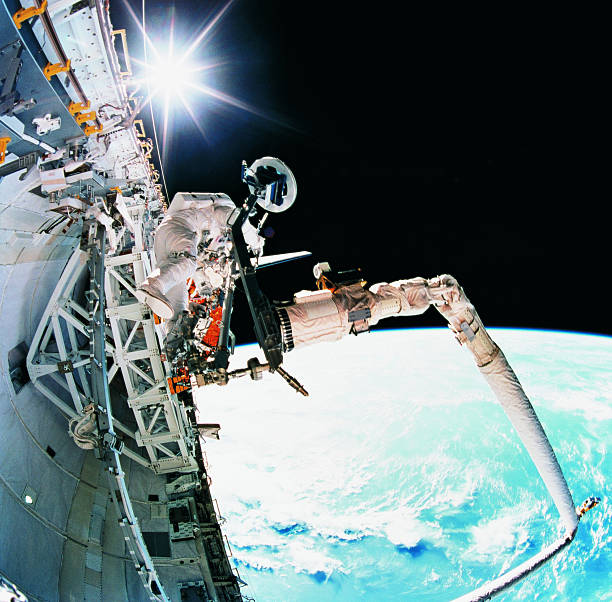
Spacelab was built by the European Space Agency as a quid-pro-quo: Europe got a seat at the table for NASA’s post-Apollo human spaceflight plans, and NASA got a ready-made lab without footing the full development bill. The core module was a cylindrical pressurized compartment, 23 feet long and 13.5 feet in diameter, that fit snugly in the Shuttle’s cargo bay. It connected to the crew cabin via a tunnel, so astronauts could float in and work in shirtsleeves. The system also included unpressurized pallets for experiments that needed direct exposure to vacuum, like astronomy sensors or materials exposed to atomic oxygen.
The first Spacelab mission, STS-9 in November 1983, was a shakedown flight with a full science crew. The module carried over 70 experiments covering life sciences, astronomy, and materials processing. That flight alone demonstrated that you could launch a fully equipped lab, run intense experiments for a week, and bring the crew and samples back to Earth—no long wait for analysis, no robotic relay. That was the killer feature Spacelab offered over early space stations like Skylab or Salyut: return. You could get your biological samples, your semiconductor crystals, your alloys back into terrestrial labs within hours of landing, not months.
Over the next fifteen years, Spacelab missions attacked specific science problems with a focus you don’t always get on a permanent station. Take the Spacelab Life Sciences missions, SLS-1 and SLS-2, flown in 1991 and 1993. They were dedicated entirely to understanding how the human body responds to weightlessness—cardiovascular changes, bone density loss, immune system shifts. These flights used the Spacelab module as a flying medical research facility with centrifuges, refrigerated incubators, and even a lower-body negative pressure device to simulate gravity effects. The data from those missions directly informed the countermeasures astronauts use today on the ISS.
Then there were the materials science missions. Spacelab’s Microgravity and Materials Processing facility, flown on multiple flights, grew crystals for electronics, studied fluid dynamics without buoyancy, and tested new alloys. The German D1 and D2 missions (Spacelab D1 in 1985 and D2 in 1993) were essentially national science programs put inside the Shuttle. Germany funded their own experiments, trained their own payload specialists, and ran the lab around the clock in shifts. That kind of international partnership—where a foreign country buys a whole mission and operates it—was unprecedented at the time. It proved that commercial and foreign entities could do serious microgravity R&D without building their own rockets or stations.
Spacelab also enabled astronomy from the Shuttle. The Astro-1 mission in 1990 carried ultraviolet telescopes on pallets in the open payload bay, studying everything from active galactic nuclei to the gas giants. Astro-2 in 1995 repeated the trick with upgraded instruments. These weren’t just side projects; they produced peer-reviewed science on star formation and interstellar medium that held up against dedicated observatory data. The fact that you could launch a telescope, operate it for nine days, then land and recover the instruments made Spacelab a flexible platform for tech demos and riskier observations that didn’t warrant a multi-year, multi-billion-dollar satellite.
But Spacelab’s real legacy isn’t just the papers it produced. It was the operational model. Every Spacelab mission had a dedicated payload operations control center at Marshall Space Flight Center, where a team of scientists and engineers monitored experiments in real time. That ground team could talk directly to the astronauts running the module, tweak parameters, and even upload new procedures mid-flight. That same concept now runs the ISS payload ops and even the private sector’s cargo missions. Spacelab also trained a generation of astronauts to be hands-on scientists, not just pilots or commanders. The payload specialist role—where a civilian expert flew alongside NASA astronauts—started with Spacelab and continues today with mission specialists who hold PhDs in biology, physics, or engineering.
In the end, Spacelab was a bargain. The module cost about one billion dollars in 1970s money, spread across the ESA and NASA partnership. For that price, the US and Europe got 22 flights’ worth of data, hardware, and experience that directly fed into the ISS laboratory modules like Destiny and Columbus. Without Spacelab, the transition from short Shuttle flights to a permanent station would have been clumsier and slower. It was the proof-of-concept that human-tended microgravity science could work, pay off, and be done without a dedicated station. And it gave the Shuttle a job beyond taxi service—a genuine scientific mission that still pays dividends today.
Space News
Latest Articles
New rockets, upcoming launches, and the stories shaping humanity's push off this planet. No astronomy degree required.