The docking targets and the visual cues
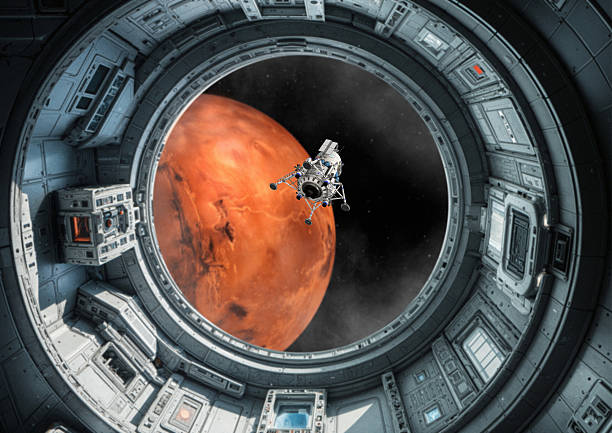
The core problem of docking in space is that every single reference point you use on Earth is gone. No horizon. No depth perception from atmospheric haze. No fixed background to judge closure rate. Your spacecraft is moving relative to the station, the station is moving relative to Earth, and both are moving relative to the sun. Without a reliable visual reference, a human pilot or an autonomous system has no way to confirm alignment, range, or approach angle. That is where docking targets come in.
The most famous docking target design is the one used on the International Space Station. It is not flashy. It is a flat, circular plate with a crosshair pattern, often surrounded by concentric rings. The pattern is printed in high-contrast black and white or sometimes with retroreflective material. When a spacecraft like Crew Dragon or Soyuz approaches, onboard cameras lock onto that pattern. The computer measures the distance between known points on the target, calculates the angle of the spacecraft relative to the plate, and feeds that data into the guidance system. Every pixel shift tells the computer exactly how far off center you are and how fast you are drifting.
But the visual cue system is not just for machines. Human pilots train extensively to read these targets by eye. When a commander looks out a window at a docking target, they are not just seeing a bullseye. They are seeing a geometric puzzle. The rings on the target are spaced at specific intervals. When the spacecraft is too far away, the rings look compressed. As you get closer, the rings expand radially. A trained pilot can estimate range to within a few centimeters just by how those rings fill their field of view. The crosshair in the center tells them if they are coming in straight or if they are skewed. If the vertical line of the crosshair tilts relative to the window frame, you are yawing. If the horizontal line shifts up, you are pitching. One glance and a veteran pilot knows if they need to fire thrusters left, right, up, or down.
Modern spacecraft have moved beyond simple painted plates. The NASA Docking System, used on the International Space Station and upcoming lunar outposts, incorporates active visual markers. These are not passive prints but small arrays of light emitting diodes that flash in a specific sequence. The approaching spacecraft has a sensor that reads these flashes. Because the lights are active, they work in total darkness, which is critical since the station passes into Earth’s shadow every ninety minutes. The flashing sequence also acts as a digital handshake. The sensor confirms it is looking at the correct target and not, for example, a random reflection off a solar panel.
The most extreme version of visual cue technology is found on the pads used for satellite servicing missions. When a spacecraft needs to grapple a satellite that was never designed to be grabbed, engineers bolt a custom docking target onto the satellite during its design or attach one via a robotic arm. These targets often have multiple facets with different patterns. One facet handles far field approach, another handles close range alignment, and a third gives the final go or no go for contact. Some targets are shaped like truncated cones, so the approaching probe physically guides itself into the capture mechanism. That is not just visual cueing. That is mechanical alignment combining with optical navigation.
What makes this technology essential for the future is not the International Space Station. It is the planned commercial space stations from Axiom Space, Blue Origin, and others. Those stations will have multiple docking ports, sometimes on the same module. Each port needs its own unique target pattern so the spacecraft knows which port it is aiming for. With multiple vehicles potentially docking at the same time, the visual cues become a traffic control system. The targets tell your ship not just where to go but when to hold position and wait.
The next step is fully autonomous docking using computer vision trained on these markers. SpaceX already demonstrated this with Crew Dragon. The spacecraft flew itself to the station, locked onto the target, and completed the final approach without the crew touching a thing. The visual cues allowed the onboard computer to extract six degrees of freedom information: three for position and three for orientation. That is the same data a pilot gets from looking out the window, but the computer gets it faster and without blinking.
The bottom line is that a docking target is not a decoration. It is a sensor interface. It is the single piece of hardware that translates a high speed orbital intercept into a gentle, controlled attachment. For every satellite serviced, every crew rotated, every module added to a station, those black and white patterns or blinking lights are doing the heavy lifting. And as space tourism ramps up, every passenger capsule that docks with a commercial station will be guided by the same visual cues that have kept docking safe for decades. The targets are small, cheap, and utterly critical. That is the kind of unsung technology that makes space travel possible.
Space News
Latest Articles
New rockets, upcoming launches, and the stories shaping humanity's push off this planet. No astronomy degree required.