The First Light: How the Universe Went From Total Darkness to a Sky Full of Stars
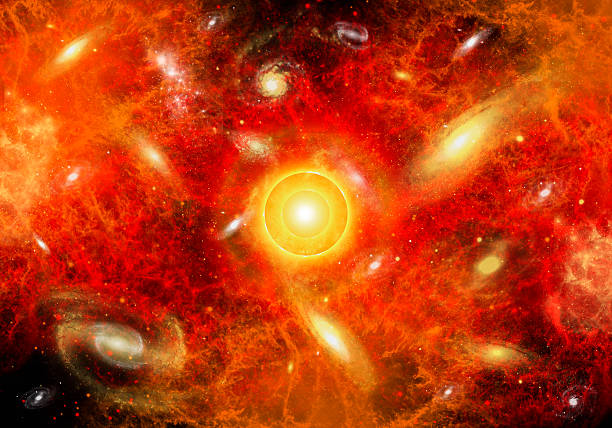
The CMB isn’t a picture of the Big Bang itself. It’s a picture of the last moment the universe was opaque. Think of it as a wall of light that got released when the fog lifted. At the time, that light was hot, visible, or ultraviolet. Over 13.8 billion years, the expansion of space stretched its wavelength. Now it sits in the microwave part of the spectrum, about 2.7 degrees above absolute zero. That’s why we call it the cosmic microwave background. It’s not a faint glow from some distant star. It’s the afterglow of the early universe, and it’s everywhere. You could build a radio receiver and pick up a tiny piece of it.
What makes the CMB useful is not just that it exists. It’s that it has tiny temperature variations. Those variations are one part in 100,000. They show where the early universe was slightly denser or less dense. Denser regions had more gravity, so they pulled in more matter. Over millions of years, those little lumps grew into galaxies, clusters, and superclusters. The CMB is basically the blueprint for everything we see today. Without those ripples, the universe would be a smooth, boring void. Instead, you get stars, planets, and eventually people arguing about the Big Bang on the internet.
After the CMB was released, the universe entered the cosmic dark ages. No stars yet. No galaxies. Just neutral hydrogen gas, dark matter, and radiation cooling off. That period lasted maybe 100 to 200 million years. Then the first stars ignited. They were massive, probably hundreds of times heavier than the Sun. They burned hot and fast, and they died young. Those first stars are called Population III stars. We haven’t seen them directly yet. They’re too far away, too faint, and too early. But they changed everything. Their ultraviolet light ripped electrons off neutral hydrogen again. That process is reionization. It cleared the fog for good and made the universe transparent to visible light over huge distances.
The first light from those stars is a big target for future telescopes. NASA’s James Webb Space Telescope is already hunting for early galaxies. Its infrared instruments can see light that has been stretched by billions of years of expansion. Future observatories like the Nancy Grace Roman Space Telescope and ground-based giants like the Extremely Large Telescope will push deeper. They want to catch the moment reionization started. That’s the real first light: not the CMB, but the first starlight that turned the universe from a cold, neutral haze into something active. If you can find that, you can figure out when the first stars formed, how big they were, and how they seeded the elements that make up your body.
Why should you care? Because deep space travel and colonization talk is fun, but none of it makes sense without the Big Bang framework. The CMB tells us the universe has a beginning, it’s expanding, and it’s about 13.8 billion years old. It also tells us the ordinary matter we’re made of is only about 5 percent of the universe. The rest is dark matter and dark energy. If you want to go to Mars or mine asteroids, you’re still stuck inside a universe governed by those numbers. The first light is not just ancient history. It’s the calibration data for every mission, every telescope, and every map of the cosmos.
The next time you see a static-filled TV screen or a fuzzy microwave map, remember: that’s not noise. That’s the oldest signal we can detect. It’s the universe’s first baby picture, and it’s still broadcasting. The first stars came later, and we’re just now building the tools to see them. That’s the frontier. Not just going farther, but looking earlier.
Space News
Latest Articles
New rockets, upcoming launches, and the stories shaping humanity's push off this planet. No astronomy degree required.