The Moon as a gas station for Mars
The core problem with Mars is simple: gravity and distance. Earth’s gravity well is deep. Every pound you want to send to Mars has to fight through 9.8 meters per second squared of pull, which means massive amounts of fuel just to get off the ground. And once you’re in orbit, you still need enough propellant to accelerate toward Mars, brake into orbit there, and then land. That’s a lot of chemical energy. The current math says that a direct Earth-to-Mars mission requires a rocket the size of a skyscraper, with most of that mass being fuel. That’s expensive, risky, and inefficient.
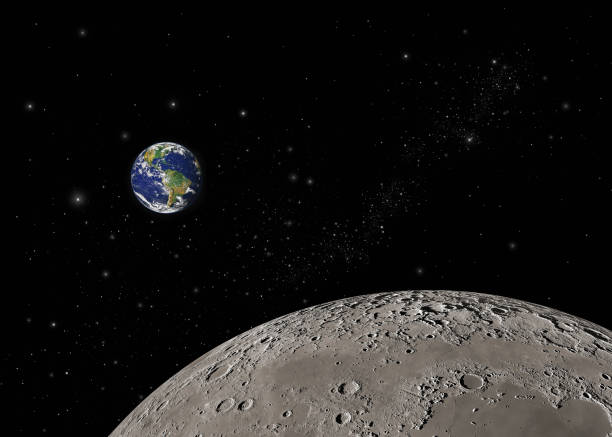
The Moon changes the math entirely. It has one-sixth of Earth’s gravity, so lifting off from the lunar surface requires far less energy. But more importantly, the Moon is a source of raw materials that can be turned into rocket propellant. The key is water ice. We’ve confirmed that the Moon’s south pole—specifically in permanently shadowed craters—holds billions of tons of water ice. Extract that water, split it into hydrogen and oxygen via electrolysis, and you’ve got liquid rocket fuel. Not some exotic sci-fi fuel, but good old LH2 and LOX, the same stuff that powers many of our rockets today. That means you don’t have to drag all your Mars fuel up from Earth. You mine it, refine it, and store it on the Moon.
Think of it like planning a cross-country road trip from New York to Los Angeles. You could load up your car with every gallon of gas you’ll need from your driveway, but you’d be hauling thousands of pounds of dead weight for the first two thousand miles. Or, you could fill up a smaller tank, drive to a gas station in Kansas, and top off there. That’s the Moon. It’s the Kansas of the inner solar system. By establishing a fuel depot on the lunar surface or in lunar orbit, we can drastically reduce the initial mass needed to leave Earth. You launch a relatively light Mars-bound spacecraft, rendezvous with a lunar fuel tanker, fill the tanks, and then fire your engines for the trans-Mars injection burn. You’re not fighting Earth’s gravity with a full load of fuel. You’re topping off with propellant that was never lifted out of Earth’s gravity well in the first place.
This is where the “Return Plans” part of the equation comes in. The Moon isn’t just a one-way gas station. It’s also your return ticket. When a crew lands on Mars, they’ll need to eventually get back home. That means lifting off from Mars, which has about 38% of Earth’s gravity, and then making the months-long trip back. That also requires fuel. If you try to bring all the return fuel with you from Earth, you double your problems. But if you can produce fuel on the Moon, you can also produce fuel on Mars. The same water ice is abundant on Mars, buried under the surface. So you can send a robotic mission ahead of your crew to mine Martian water and produce return propellant. The lunar gas station is the prototype for the whole system. It proves the technology, the logistics, and the economic model of using local resources instead of bringing everything from home.
Some people will argue that it’s an unnecessary detour. Why build a Moon base just to fuel Mars missions? Can’t we just build bigger rockets and go direct? The answer is that bigger rockets are possible, but they’re astronomically expensive. A super-heavy-lift rocket like SpaceX’s Starship is designed to be fully reusable and refuelable in orbit, which does change the equation. But even Starship plans to use orbital refueling—essentially a gas station in low Earth orbit. That gas still has to be launched from Earth. The Moon offers a cheaper, more sustainable source of that gas because it’s already sitting there, untapped. Plus, the Moon provides a permanent, low-gravity hub for assembling and maintaining larger spacecraft. It’s a staging area, a repair shop, and a fuel pump all in one.
The bottom line is that the Moon isn’t a distraction from Mars. It’s the prerequisite. The established plans from NASA and commercial partners like SpaceX and Blue Origin all point to the Moon as the critical stepping stone. The Artemis program is already building the infrastructure—the Gateway orbital station, the landers, the mining experiments. Every mission to the Moon from here on out is a test run for the technology that will eventually send boots to Martian soil. You don’t build a highway to another state without first building a rest stop. The Moon is that rest stop. It’s where we fill the tank, check the tires, and push onward. For any guy who’s ever driven cross-country knowing exactly where the next gas station is, you already get it. The Moon is just a lot farther from the interstate, and the payoff is a whole other planet.
Space News
Latest Articles
New rockets, upcoming launches, and the stories shaping humanity's push off this planet. No astronomy degree required.