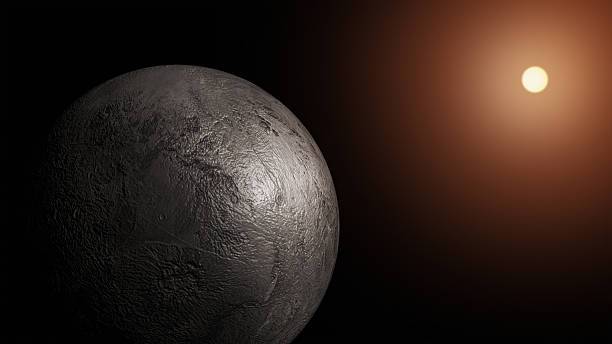
Titan atmosphere and the Dragonfly rotorcraft mission

Titan is Saturn’s largest moon, bigger than Mercury. But what makes it a destination isn’t its size. It’s the atmosphere. Titan is the only moon in the solar system with a substantial atmosphere. In fact, its atmospheric pressure at the surface is about 1.5 times that of Earth. That means you could walk around on Titan without a pressure suit—just a heavy parka and an oxygen mask. The air is mostly nitrogen, like ours, but laced with methane and ethane. And it’s thick: four times denser than Earth’s atmosphere. That thickness is exactly why Dragonfly wasn’t designed as a rover. A rover would be slow and limited. On Titan, you can fly.
Dragonfly is a quadcopter, about the size of a small car, with eight rotors. It will launch in 2028 and arrive at Titan in 2034. That’s a long trip, but Titan’s atmosphere makes it worth the wait. The thick air and low gravity—just 14 percent of Earth’s—mean Dragonfly can fly easily, covering tens of kilometers in a single hop. Over its two-year prime mission, it will travel hundreds of kilometers across Titan’s surface. This isn’t just a science mission; it’s a proof of concept for aerial exploration on other worlds. If it works, we’ll see flying drones on Mars, Venus, and beyond.
What will Dragonfly find? Titan is a deep freeze, with surface temperatures around minus 290 degrees Fahrenheit. But it’s not a dead world. It rains methane. Rivers of liquid methane carve through water-ice mountains. Dunes made of hydrocarbon sand stretch for hundreds of miles. And beneath that icy crust, scientists suspect there’s a liquid water ocean. That combination—water, organic chemistry, and energy sources—makes Titan one of the best candidates in the solar system for finding life, or at least the building blocks of life.
Dragonfly’s main job is to sample that organic chemistry. It will land in the equatorial region, near dunes that look like those in Namibia but are made of tholins—complex organic compounds created when sunlight hits methane in the upper atmosphere. These are the same kinds of molecules that may have been the precursors to life on Earth. Dragonfly will scoop up samples, heat them, and analyze the gases that come off. It will also drill into the water ice to see what’s underneath. Every hop gives it a new site, a new piece of the puzzle.
The mission is part of NASA’s New Frontiers program, the same line that sent New Horizons to Pluto and Juno to Jupiter. That means it’s high-risk, high-reward, and built to be efficient. Dragonfly uses a Multi-Mission Radioisotope Thermoelectric Generator to keep warm and powered through the cold Titan nights, which last eight Earth days. The rotors are designed to handle the thick, cold air, and the landing gear can handle soft sand or hard ice. The engineering is brutal and practical, exactly the kind of hardware American aerospace engineers excel at.
Why does this matter to you? Because Titan is a destination that changes how we think about exploration. We’ve landed on Mars, Venus, and the Moon. But we’ve never flown on another world. Dragonfly will do that. It will give us a view of Titan that no orbiter or rover can match: a bird’s-eye perspective of dunes, impact craters, and probably active methane rivers. If there’s a methane cycle similar to Earth’s water cycle, Dragonfly might witness storms, evaporation, and even flash floods of liquid methane. That’s not science fiction. That’s a mission that’s funded, built, and on its way.
The Saturn system is already a place of wonder, with its rings, its dozens of moons, and the subsurface oceans of Enceladus. But Titan is the crown jewel of that system—a world with weather, geology, and chemistry that mirrors Earth in surprising ways. Dragonfly is the next step in making that world real for the public. It’s not just a probe. It’s a flying laboratory heading to one of the most exotic places in the solar system. For anyone who follows space travel, this is the destination to watch in the 2030s.
Space News
Latest Articles
New rockets, upcoming launches, and the stories shaping humanity's push off this planet. No astronomy degree required.