Antimatter and the storage problem
Antimatter works because when a particle meets its antiparticle, they annihilate completely, converting 100% of their mass into energy. Chemical rockets, by contrast, convert only about 0.0000001% of their propellant’s mass into usable thrust. That’s a difference of roughly a billion to one. For deep space missions, antimatter engines could theoretically cut travel times by factors of ten or more. But first, you have to keep the fuel from blowing you to pieces before you even light the engine.
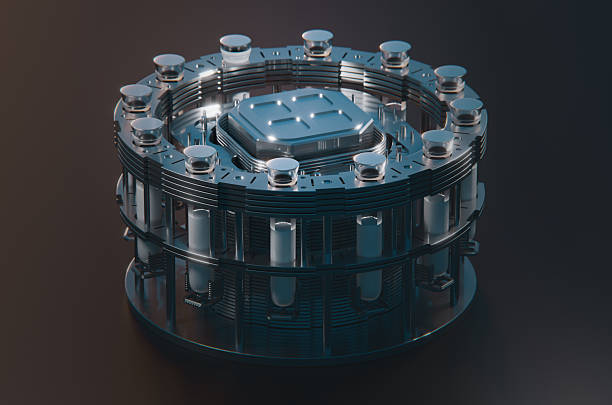
The storage problem is brutal. Antimatter cannot touch normal matter—ever. A single contact with the wall of a tank would trigger instant annihilation, releasing enough energy to destroy the container and everything around it. So you cannot pour it into a steel cylinder. You cannot freeze it into pellets. You cannot put it in any physical container at all. The only option is magnetic or electric confinement—basically, levitating suspended clouds of antiprotons or positrons inside a vacuum chamber using powerful electromagnetic fields.
On paper, this works. Penning traps and Paul traps can hold small numbers of charged antiparticles for months. CERN routinely stores antiprotons for experiments without incident. The problem is scaling up. For a meaningful space mission, you’d need grams or even kilograms of antimatter. Current traps handle microgram-scale quantities at best, and they require enormous, power-hungry magnets and cryogenic cooling. A spacecraft would need to carry a full-scale particle accelerator and cryostat just to keep its fuel in check. That adds mass, complexity, and vulnerability.
Worse, the energy required to maintain these traps is not trivial. If the power fails—from a solar panel malfunction, a micrometeoroid strike, or a simple electrical glitch—the magnetic field collapses instantly. The antimatter then drifts into the walls of its trap and annihilates. The result is not a gradual shutdown but a catastrophic explosion. For a ship carrying a kilogram of the stuff, that explosion would be roughly equivalent to the Tsar Bomba, the largest nuclear weapon ever detonated. You don’t just lose propulsion; you lose the entire ship and anything within a few kilometers.
So why keep trying? Because if you solve storage, you solve the fuel problem for the entire solar system and beyond. Antimatter rockets have exhaust velocities that approach the speed of light. A trip to Mars could take weeks instead of months. A mission to Jupiter’s moons could become a year-long round trip instead of a decade-long one. And interstellar probes, which today require absurdly massive fusion reactors or laser sails, suddenly become feasible with a few hundred grams of fuel.
Various concepts have been proposed to make storage workable. One idea is to store antimatter as a solid state—binding antiprotons into antihydrogen, then freezing it into pellets coated with a thin layer of neutral material that prevents immediate contact. This is known as an “ice pellet” approach, but it remains theoretical because nobody has ever produced enough antihydrogen to even attempt it. Another concept uses rotating magnetic rings that create a toroidal storage volume, similar to a tokamak but scaled down. These would be lighter than traditional Penning traps but require exotic superconducting materials that don’t exist yet.
Private companies have shown interest. NASA’s Institute for Advanced Concepts has funded antimatter storage studies, and entities like Positron Dynamics have worked on portable positron traps for industrial applications like positron emission tomography. But none of these efforts are close to a flight-ready system. The gap between what we can trap (nanograms) and what we need (grams) is still millions of times wider than any current technology can bridge.
The bottom line for any casual space fan is this: antimatter propulsion will not happen until someone invents a storage system that is lightweight, failsafe, and scalable. Right now, we have none of those things. Magnetic traps work but are too heavy. Ice pellets are clever but unproven. Every proposed solution requires a breakthrough that we cannot predict. That said, the potential payoff is so enormous that the research continues, slowly and deliberately, in labs that can afford to handle antimatter without blowing themselves up. For now, chemical rockets and ion thrusters remain our only practical options. But the day someone solves the storage problem, everything changes.
Space News
Latest Articles
New rockets, upcoming launches, and the stories shaping humanity's push off this planet. No astronomy degree required.