Deep space network and the three-station layout
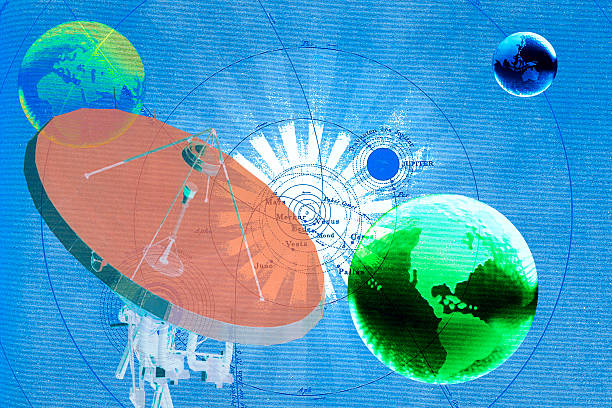
The DSN is built around three complexes: Goldstone in California, Madrid in Spain, and Canberra in Australia. They are spaced roughly 120 degrees apart in longitude. That means no matter where Earth is spinning, at least one station is always facing the deep sky. Since a spacecraft in deep space is a point source emitting a whisper-thin radio signal, you can’t just rely on a single dish that will eventually rotate out of view. The three-station layout provides continuous coverage. When Goldstone sets, Madrid rises. When Madrid sets, Canberra picks it up. It’s a relay that never sleeps.
Each complex is equipped with massive parabolic dishes—34 meters and 70 meters in diameter. The 70-meter dishes are the big guns, capable of catching signals as faint as a billionth of a billionth of a watt. To put that in perspective, that’s about the same as trying to hear a single raindrop hitting the ground from across an entire football stadium. The dishes are steerable, precise to fractions of a degree, and they must contend with Earth’s atmosphere, weather, and even thermal expansion of the metal. But the three-station layout solves the biggest problem: line-of-sight. A spacecraft beyond low Earth orbit is visible only from one hemisphere at a time. Without three stations, you’d lose contact for eight to twelve hours every day. For a mission like the Voyager probes, still transmitting from interstellar space, that’s not just inconvenient—it’s a lost opportunity to collect data that took decades to gather.
The technology behind the DSN is deceptively simple: radio antennas, amplifiers cooled to near absolute zero to reduce thermal noise, and sophisticated phase-locked loops that track extremely weak carrier waves. But the real engineering challenge is the handoff. When Goldstone loses line-of-sight as Earth rotates, the DSN control center in Pasadena must transfer the connection to Madrid with zero interruption. This isn’t like a cell tower handoff where a phone can drop a bit of data and reconnect. A deep space link is a continuous stream of bits carrying commands, telemetry, and scientific data. Lose sync, and you might not reacquire for an hour—or, in worst cases, lose the spacecraft entirely. So the three stations are linked by high-bandwidth terrestrial lines. They’re essentially one giant antenna that happens to be spread across the globe.
Why three and not two? Geometry. With two stations, you’d still have a gap. The Earth covers 120 degrees per station roughly, so two stations spaced 180 degrees apart would give you a seamless horizon-to-horizon view only if both stations could see the same spacecraft simultaneously. But because Earth is a sphere and the spacecraft is in a different plane, two stations would leave a blind spot when both are on the opposite hemisphere of the target. Three stations, each 120 degrees apart, ensure that at least one is always in the half of the globe facing the spacecraft. It’s not perfect—when a station is in the middle of the night, atmospheric noise increases, and storms can degrade performance—but it’s the best we’ve got. And it’s been working for over fifty years.
For the casual space enthusiast, the DSN is the unsung hero behind every major mission. When you see a photo of Mars’ Jezero Crater from Perseverance, that image came through the DSN. When the James Webb Space Telescope sends back those infrared deep fields, the data stream passed through a 34-meter dish in Canberra or Madrid. The three-station layout is also critical for guidance and navigation. The DSN doesn’t just receive data. It sends commands. When mission control wants to tweak a spacecraft’s trajectory to avoid a collision or adjust an orbit insertion burn, that command must reach the vehicle precisely when it’s above a station. Without continuous coverage, that window shrinks. If you miss it, you wait another day or more. In deep space, time is delta-v, and delta-v is precious.
None of this is science fiction. It’s boring, reliable, and brutally necessary engineering. The DSN is scheduled decades in advance. Every minute of dish time is allocated, often to multiple missions via time-sharing. And as humanity pushes into the outer solar system with missions like Europa Clipper and the Mars Sample Return campaign, the strain on the network will only grow. NASA is already upgrading to more capable antennas and implementing optical laser communication, but the three-station layout isn’t going anywhere. It’s the foundation.
So next time you’re reading about a new picture from the edge of the solar system, remember that image traveled a hundred million miles, weak as a whisper, and was caught by a dish in the middle of an Australian sheep station. The DSN is the black box of guidance and navigation—silent, reliable, and the only reason we know what’s out there.
Space News
Latest Articles
New rockets, upcoming launches, and the stories shaping humanity's push off this planet. No astronomy degree required.