Iapetus and the equatorial ridge mystery
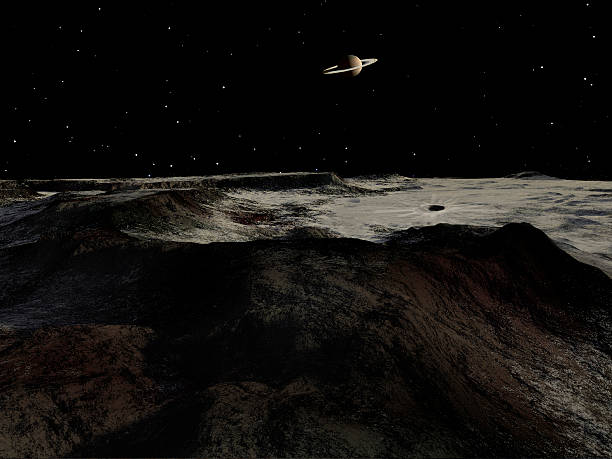
If you are a casual space enthusiast keeping up with the future of space travel, you need to know about Iapetus because it is a destination that challenges everything we think we know about how moons form and evolve. And the biggest question mark hanging over this world is the equatorial ridge.
First, let us get the basics out of the way. Iapetus is Saturn’s third-largest moon, roughly 1,470 kilometers in diameter. It was discovered by Giovanni Cassini in 1671. Cassini noticed something odd right away. He could see Iapetus on one side of Saturn but not the other. That is because the moon is tidally locked, and one hemisphere is covered in dark material while the other is bright white ice. The dark side reflects only about five percent of sunlight. The bright side reflects about fifty percent. That two-tone paint job alone is weird, but it is not the strangest thing about Iapetus.
The strangest thing is the ridge.
Running along the equator of Iapetus, almost perfectly aligned with the moon’s equator, is a mountain range that rises more than 20 kilometers above the surrounding terrain in some places. That is roughly the height of Mount Everest, but instead of being a single peak, it is a continuous wall that stretches for more than 1,300 kilometers. It wraps nearly three-quarters of the way around the moon. This is not a volcanic chain. It is not a fault line. It is a ridge that sits exactly on the equator, and no one has a slam-dunk explanation for how it got there.
Here is why this matters for future space travel. If we ever send a crewed mission to the Saturn system, Iapetus will be a high-priority destination. It is far enough from Saturn that radiation doses are lower than around the inner moons. Its surface gravity is about 2.2 percent of Earth’s, so landing and launching are relatively cheap in terms of fuel. But the real draw is the ridge itself. Scientists have been arguing about its origin for decades, and the answer could reshape our understanding of planetary formation.
There are a few leading theories. One says that Iapetus once had its own ring system. Early in its history, debris from a collision or a captured object formed a ring around the moon. Over millions of years, that ring material rained down onto the equator, building up into that massive ridge. Another theory suggests that Iapetus spun much faster in the past. It was rotating so fast that the equator bulged outward, and then the moon froze in place before the bulge could relax. The problem with that idea is that Iapetus would have needed to spin once every few hours, and it would have been a very different shape. A third theory involves cryovolcanism, where ice volcanoes erupted along the equator and deposited material in a linear pattern.
None of these explanations are perfect. The ring theory has the problem of scale. The ridge is huge. You would need a lot of ring material, and you would have to explain why it all ended up on the equator and not elsewhere. The fast-spin theory struggles with the moon’s current shape, which is not flattened at the poles the way you would expect from a fast-spinning body. The cryovolcanic idea lacks a good reason for why the eruptions would follow the equator so precisely.
What makes Iapetus even more mysterious is that it has other oddities. The dark side of the moon is coated in a material that is likely organic compounds, possibly cooked by radiation from Saturn. That coating may be related to the ridge, or it may be a separate phenomenon entirely. We do not know. Cassini flew past Iapetus several times between 2004 and 2007, and it gave us the best images we have. Those images show the ridge in stunning detail. It looks like a wall, with some sections rising so steeply that they cast long shadows across the cratered plains below. In some places, the ridge is interrupted by massive landslides. In others, it splits into parallel segments. It looks artificial, but it is not. It is natural, and we have no idea how nature built it.
For American men in their twenties who follow space travel, Iapetus represents the kind of frontier that demands exploration for its own sake. It is not a resource bonanza like the asteroid belt. It is not a potential colony site like Mars. It is a mystery. And mysteries are exactly what drive people to build rockets and go places. If you want to keep up with the future of space travel, you need to understand that destinations like Iapetus are why we go. Not for the money. Not for the glory. For the ridge.
Space News
Latest Articles
New rockets, upcoming launches, and the stories shaping humanity's push off this planet. No astronomy degree required.