Habitat construction and the 3D-printed regolith walls
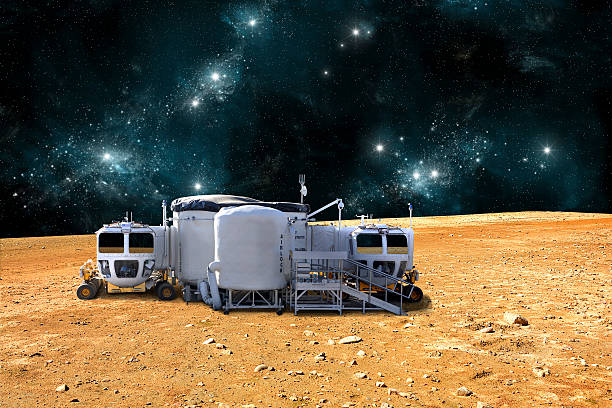
Think about the physics. A Mars base doesn’t have a Home Depot. Every pound of construction material you launch from Earth costs roughly $10,000 in fuel. A single shipping-container-sized habitat module? That’s a quarter-million dollars just to get it off the pad, and that’s before you burn the extra delta-v to land it on the red planet. You run the numbers, and you realize that shipping concrete is a one-way ticket to bankruptcy. The alternative is sitting right there on the surface: regolith. That fine, iron-rich dust and crushed rock covering every inch of Mars. It’s free. It’s abundant. And with the right printer, it becomes a fortress.
Here’s how it actually works. A rover-sized 3D printer, already tested in labs on Earth, trundles over the Martian terrain. It scoops up regolith, mixes it with a binding agent—usually a sulfur-based polymer or a magnesium chloride brine—and extrudes layer after layer of compressed, hardened material. The machine doesn’t need air. It doesn’t need a crew. It just needs power, which you can get from solar panels or a small nuclear reactor. Within weeks, that printer can raise a dome-shaped wall nearly ten feet thick. That thickness isn’t for insulation. It’s for radiation.
Mars has no magnetic field and a paper-thin atmosphere. Without protection, the surface radiation dose is about 50 times what you’d get on Earth. You’d hit your lifetime cancer limit in about 18 months. A regolith wall just two meters thick cuts that radiation to Earth-level safe. No lead shielding. No buried modules. Just dirt, printed into place.
The structural side matters too. Martian gravity is only 38% of Earth’s, which sounds like a perk—lighter loads, easier lifting. But it also means that wind gusts can hit 60 miles per hour during dust storms, and the temperature swings from 70 degrees Fahrenheit at noon to minus 100 at night. A printed regolith wall handles that thermal cycling better than metal because the material has low thermal conductivity. It stays warmer inside when the sun drops, and it doesn’t expand and contract like aluminum. You don’t get fatigue cracks. You get a stable, passive shell.
The Decade Plan lays out a specific sequence. First wave: uncrewed landers drop printers and binding agents. Second wave: the printers build a primary habitat dome, plus a second dome for equipment storage. Third wave: humans arrive to an already-constructed base. They don’t swing a hammer. They don’t mix cement. They walk inside, seal the airlocks, and start pumping breathable atmosphere. That’s the efficiency you need when you’re 140 million miles from the nearest hardware store.
There are critics, of course. Some argue that the testing on printed regolith in vacuum chambers and low-gravity simulators doesn’t perfectly replicate Mars conditions. The dust is electrostatically charged, and the sulfur binders might outgas under ultraviolet radiation. Fair points. But the alternative—building with Earth-imported materials—is a logistical nightmare that stretches the timeline to the 2050s at best. Every engineer I’ve talked to at ICES and the Mars Society agrees: regolith printing is the only path that scales. You can’t build a city by shipping bricks.
Look at the prototype work already done. ICON, the same company that printed houses for homeless veterans in Texas, has run vacuum-chamber tests with simulated Martian dirt. Their printer produced a sample wall that held pressure and survived thermal cycles equivalent to a Martian year. NASA’s Kennedy Space Center has its own regolith simulant and has printed interlocking blocks that require no mortar—just compression and heat. The technology is past the proof-of-concept stage. It’s at the refinement stage.
So when you read about the Mars Colony and the Decade Plan, understand that 3D-printed regolith walls aren’t some futuristic gimmick. They’re the foundation—literally—of permanent human presence on another planet. The rocket gets you there. The printer keeps you alive. And if the plan holds, your grandkids might walk through a Martian door made of Martian rock, built by a machine that landed before the first human took a step. That’s how you colonize a world. Not with brute force. With smart dirt.
Space News
Latest Articles
New rockets, upcoming launches, and the stories shaping humanity's push off this planet. No astronomy degree required.