Ring rain and the material falling into Saturn
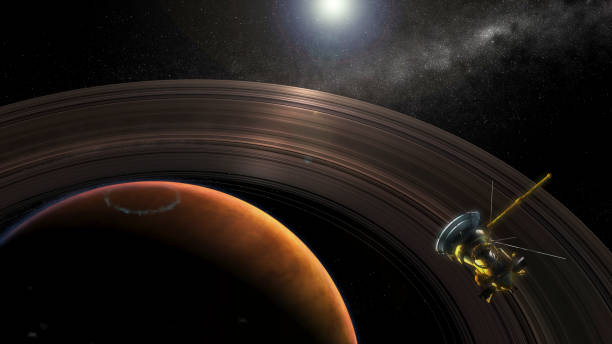
For casual space fans, the rings look solid and stable. Up close, they’re mostly chunks of water ice, dust, and rocky debris, ranging from grains of sand to boulders the size of a house. Gravity holds them in orbit around Saturn, but nothing in space stays put forever. Saturn’s magnetic field, its gravity, and even sunlight are slowly eroding those rings. The result is a constant, steady stream of material called ring rain—particles that break free from the ring system and fall into Saturn’s atmosphere.
The discovery of ring rain came from NASA’s Cassini mission, which orbited Saturn from 2004 to 2017. Before Cassini, scientists knew rings changed, but they had no idea how fast. Cassini’s instruments detected water molecules and other material falling from the innermost D ring into Saturn’s equatorial region. The numbers are staggering: roughly 10,000 to 100,000 kilograms of ring material plunge into Saturn every second. That’s the equivalent of a fully loaded semi-truck dropping into the atmosphere every few seconds, 24/7.
Why does this matter to you? Because it changes how we understand destinations in space. Saturn’s rings aren’t a static museum exhibit. They’re a dynamic, dying system. The material falling into Saturn is actually altering the planet’s upper atmosphere, adding water, carbon dioxide, and other compounds that shouldn’t be there naturally. This contamination isn’t just a scientific curiosity. It affects Saturn’s weather, its ionosphere, and even its auroras. The rings are literally feeding the planet.
If you think of Saturn as a destination—whether for future probes or human missions decades from now—the ring rain zone is a hazard. Flying a spacecraft too close to the rings or the upper atmosphere could mean colliding with tiny particles moving at orbital speeds. That’s why Cassini’s final orbits, called the Grand Finale, dove between the rings and the planet, skimming the very edge of this rain zone. Those maneuvers gave us the clearest data on ring rain ever collected.
But there’s a bigger picture here. The rings are young in astronomical terms—maybe 100 million years old, which is a blink compared to Saturn’s 4.5 billion-year lifespan. They could be the debris from a shattered moon or a comet that got too close. And ring rain is slowly emptying them. At the current rate, the entire ring system could disappear in 300 million years. That’s a long time for humans, but a blink for the solar system. If you want to see Saturn’s rings at their full glory, you were born at exactly the right time.
So what’s the destination? It’s not just Saturn’s surface or its rings. It’s the entire dynamic region where the rings meet the planet. That boundary layer is a destination in itself—a place of constant change, where ice becomes vapor and dust becomes atmosphere. Future missions might sample ring rain directly, sending probes into the equatorial zone to collect water molecules before they’re swallowed. That would tell us the exact composition of the rings and the history of their formation.
For the space pilgrim, understanding ring rain is about accepting that nothing in the cosmos is permanent. Saturn’s rings are not eternal. They’re a temporary feature, and they’re draining away right now. That harsh reality is what makes space exploration compelling. It’s not all beautiful images and calm orbits. It’s physics, erosion, and decay. And Saturn is the perfect place to see it happen in real time.
The next time you look at a picture of Saturn, don’t just stare at those gorgeous rings. Remember that every second, a truckload of that icy debris is plunging into the planet’s atmosphere. It’s not a decoration. It’s a destination—a place where material ends its long journey from orbit to oblivion. And if you’re a guy who likes the raw, unvarnished reality of space, that’s exactly where you should focus your attention.
Space News
Latest Articles
New rockets, upcoming launches, and the stories shaping humanity's push off this planet. No astronomy degree required.