Time synchronization and the relativity correction
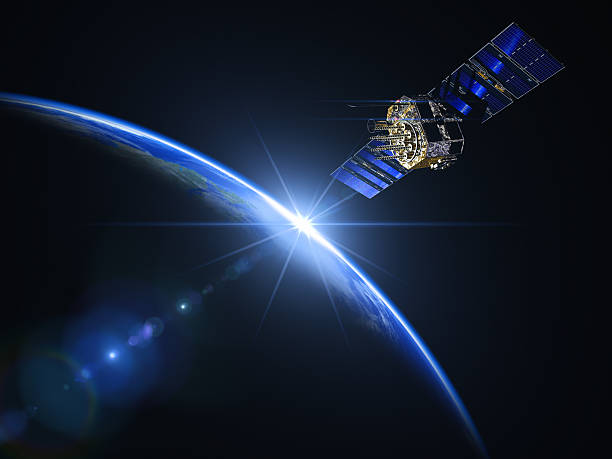
Let’s start with the basics. GPS satellites orbit Earth at roughly 12,550 miles altitude, moving at about 8,700 miles per hour. Each satellite carries multiple atomic clocks that tick with an accuracy of nanoseconds. Your receiver on the ground picks up signals from at least four satellites, measures the tiny time differences in when those signals arrived, and triangulates your position. But here’s the problem: those clocks are moving fast in a weaker gravitational field compared to clocks on Earth’s surface. Two relativistic effects kick in simultaneously.
First, special relativity says that moving clocks run slow relative to a stationary observer. The GPS satellites are moving fast, so their clocks lose about 7 microseconds per day compared to a clock on the ground. But general relativity says that clocks in a weaker gravitational field run faster. Because the satellites are higher up, away from Earth’s gravitational well, their clocks gain about 45 microseconds per day. The net result is a difference of roughly 38 microseconds per day—the satellites’ clocks run faster than ground clocks by that amount. Without correction, this cumulative error would make GPS positioning drift by about 11 kilometers per day. You would be aiming for a landing pad and ending up in the next county.
The engineering fix is straightforward but brilliant. Before launch, each satellite’s clock is deliberately set to run slightly slower than a ground clock. The offset compensates for the expected relativistic gain once in orbit. Then, ground control continually monitors each satellite’s actual time and sends fine-tuning corrections. This is not theoretical physics at a chalkboard; it is operational reality. Every time you use Google Maps or a spacecraft performs an orbital insertion burn, relativity is baked into the math.
Now, why does this matter for the “Guidance Navigation and the Black Box” section of a space enthusiast website? Because the same relativistic principles apply to every spacecraft that relies on autonomous navigation. Deep space probes, Mars landers, and future crewed missions to the Moon or beyond all need to synchronize their internal clocks with Earth-based control or with other spacecraft. The Black Box—the onboard computer and sensor suite that handles guidance—must account for time dilation or risk missing a target by kilometers.
Consider a Mars mission. The time delay for a radio signal between Earth and Mars ranges from about 4 to 24 minutes depending on planetary positions. That’s too long for real-time remote control. The spacecraft must navigate using its own sensors and its own time reference. If the onboard clock drifts even slightly due to relativistic effects from its velocity or its location in a gravitational field, the trajectory calculation will have systematic errors. For a landing sequence that requires pinpoint accuracy within a few dozen meters, a clock error of a few microseconds could mean the difference between a successful touchdown and a crash.
This is not a future problem. The Mars Science Laboratory, which landed the Curiosity rover in 2012, used relativistic corrections in its navigation algorithms. The Artemis program’s Orion spacecraft will similarly rely on precise timing for lunar orbit insertion and docking maneuvers. The Global Navigation Satellite Systems—including GPS, GLONASS, and Galileo—are all subject to these corrections. Remove relativity from the code, and every one of them falls apart.
For the casual space enthusiast, the takeaway is simple. When you hear about spacecraft “autonomy” or “precision guidance,” think about the clock. The Black Box is not just a processor and a sensor suite; it is a time management system that has to reconcile physics that most people never think about. Relativity correction is not an academic footnote. It is a non-negotiable part of the software that gets spacecraft where they need to go. If you want to keep up with the future of space travel, remember that time is not constant. And the tools we use to navigate space have learned that lesson well.
Space News
Latest Articles
New rockets, upcoming launches, and the stories shaping humanity's push off this planet. No astronomy degree required.