Eternal Inflation: The Wild Physics That Says Our Universe Is One Bubble in a Multiverse
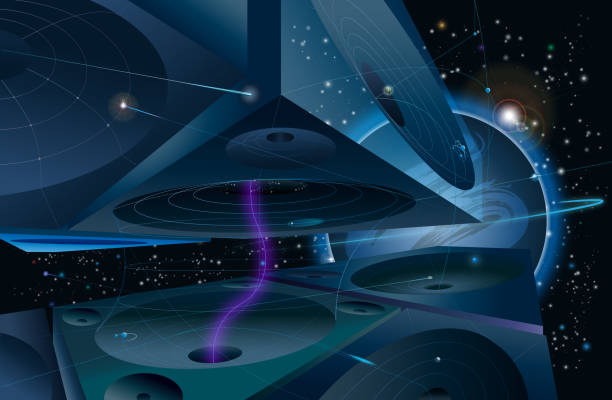
Here’s how it works. Inflation is powered by a field stuck in a high-energy state. That state is unstable. It decays like a radioactive atom. When it decays, it dumps energy into normal particles. That creates a bubble of ordinary space. Our universe is one of those bubbles. Outside the bubble, inflation keeps going. New bubbles pop off forever. Each one is a separate universe. Same basic laws, maybe different constants. Different forces. Different particles. Some might be dead. Some might be weird. We got one that works.
This isn’t sci-fi. It falls out of quantum field theory and general relativity. String theory makes it worse. The string landscape has something like 10^500 possible vacuum states. Each state could be a different universe. That number is stupid big. But the math is the math. If inflation is real, eternal inflation is hard to avoid. If eternal inflation is real, the multiverse is real. That’s the edge of cosmology.
The hard part is proof. You can’t fly to another universe. You can’t send a signal. But you might find a scar. If two bubble universes collided during inflation, the crash could leave a mark in the cosmic microwave background. A disk-shaped bruise. A cold or hot spot with a specific pattern. The CMB is the oldest light in existence. It’s a snapshot of the universe at 380,000 years old. If a bubble collision happened, it could still be in there.
Scientists have looked. The famous CMB cold spot was a candidate. It’s a large, unusually cold patch. Some researchers said it could be a collision signature. Follow-up data from Planck didn’t confirm it. It looks more like a statistical fluke. But the search isn’t over. Future experiments like CMB-S4, LiteBIRD, and the Simons Observatory will map the CMB with way more precision. They’ll hunt for non-Gaussian patterns. They’ll look for circular anomalies. If a bubble collision is there, they have a shot at finding it.
Gravitational waves are another clue. Inflation should have produced primordial gravitational waves. Those waves would leave a twist in the CMB polarization, called B-modes. Detecting them would confirm inflation happened at high energy. That would boost eternal inflation. It still wouldn’t prove the multiverse directly. But it would put us on the right road. Bubble collisions might also produce gravitational wave signatures. Not the kind LIGO sees. Different frequencies. Different sources. But future observatories could listen.
There’s a deeper problem. If the multiverse is infinite, probability breaks. Anything that can happen happens. Infinite times. So what does it mean to say our universe is typical? You need a measure. A way to count universes and assign odds. Nobody has a measure that everyone accepts. Some measures predict you should be a Boltzmann brain. A random conscious moment floating in empty space. That’s absurd. But absurd predictions are a warning sign. They mean the theory is missing something.
Critics say the multiverse is untestable. Fair. You can’t falsify it in the usual way. But it’s not a random idea. It’s a prediction of our best theories. The same theories that explain the CMB, particle physics, and dark energy. You don’t get to keep the parts you like and throw out the weird consequences. Either inflation is wrong, or the multiverse is on the table.
Why care? Because it changes the score. Humanity isn’t the center. Earth isn’t the center. The observable universe might be one bubble in an endless sea. That’s not depressing. It’s huge. It means deep space isn’t just planets and stars. It’s the structure of reality itself. The next decade of CMB data could give us the first real evidence. If we see a bubble collision, everything changes. If we don’t, the multiverse isn’t dead. It just stays on the edge. That’s where the good stuff is.
Space News
Latest Articles
New rockets, upcoming launches, and the stories shaping humanity's push off this planet. No astronomy degree required.